What Drives Up the Cost of a Bathroom Remodel in Central Florida
Bathroom remodel costs in Central Florida start around $25,000 for a guest bath and $40,000 for a primary. Here's what actually drives the price up.
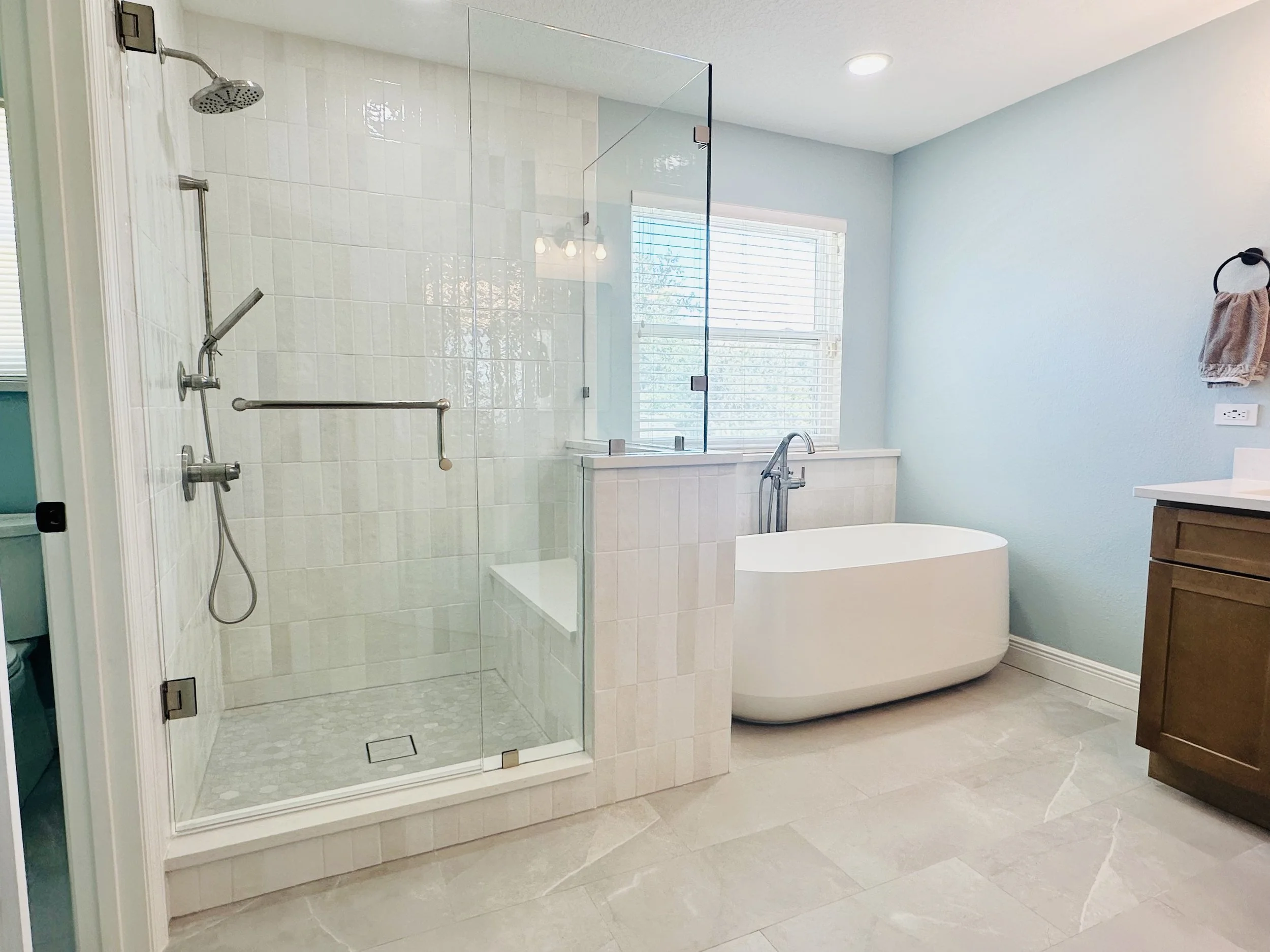
Primary bathroom remodel completed in Winter Garden, FL. Total project cost: approximately $42,000.
Bathroom remodel costs in Central Florida vary widely, but most homeowners are surprised at the answer. A guest bathroom remodel typically starts around $25,000, while a primary (master) bathroom starts around $40,000. The price difference between the two isn't proportional to the size difference, and that's the part most homeowners don't expect.
The three biggest cost drivers in any bathroom remodel are tile, electrical, and plumbing. Within those three, the specific decisions you make about layout, shower design, and material selection have a bigger impact on the final price than most homeowners realize. A small layout change can add thousands. A different shower design can save thousands.
This guide breaks down what actually drives bathroom remodel cost in Central Florida, including the specific decisions that push the budget higher, the counterintuitive truths that most homeowners get wrong, and the foundational baseline that applies to every project no matter the size.
The Big Three Cost Drivers
Tile, electrical, and plumbing are the three biggest factors in bathroom remodel cost. Each one is influenced by specific decisions, and small changes in those decisions can swing the budget by thousands.
Tile is priced by the square foot, and the shape of the space changes the cost more than most homeowners realize. The amount of tile, the type of tile, the labor to install it, and the backer board behind it all add up.
Electrical work is foundational on every bathroom remodel. New circuits, updated outlets, GFCI protection, vanity lighting, overhead lighting, and exhaust fan wiring all happen as part of the standard scope. Costs go up when you add features like sconce lighting, recessed lighting in multiple zones, or in-shower lighting. Every added fixture adds wiring, labor, and material cost.
Plumbing is where layout decisions can blow a budget fast. Keeping fixtures in their existing locations is one of the most cost-effective decisions a homeowner can make. Moving them is where the cost climbs quickly, which we'll cover in the next section.
Why Layout Changes Are Budget Killers
Layout changes are the single biggest reason a bathroom remodel goes over budget. In a small bathroom, layout changes are almost impossible to make without expanding into another room, which is rarely worth doing when you factor in the additional cost and the ROI impact.
Even in a primary bath where there's more room to work with, moving fixtures triggers a cascade of additional work.
Moving plumbing in a slab home (which is most homes in Central Florida) involves:
Cutting concrete to access the drain lines
Rerouting drain and water supply lines
Pouring concrete back after the new lines are in
Additional inspections for the plumbing work
Verifying the new location meets Florida Building Code requirements for vent stack distance
That last point catches a lot of homeowners off guard. Florida Building Code requires plumbing fixtures to be within a specific distance of a vent stack. Moving a toilet, sink, or shower beyond that distance means a new vent stack has to be run, which adds significant cost on top of the plumbing relocation itself.
Raised homes are different. Moving plumbing in a home with a crawl space underneath is much less involved because there's no concrete to cut and pour back. The drain and water lines can be accessed and rerouted from below. The cost difference between moving plumbing in a slab home versus a raised home is substantial.
A note on ROI. If you're planning to sell your home within the next few years, layout changes that drive up cost rarely pay back in resale value. If this is your forever home, ROI doesn't matter and you should make the layout work the way you want it to. Knowing which situation applies to you helps make these decisions clearer.
Shower Design, Tile, and Why More Glass Can Be Cheaper
Shower design is where the counterintuitive truths come out. Most homeowners equate open glass showers with luxury, and luxury with higher pricing. It's an understandable assumption, but it doesn't match how shower cost actually works.
Tile work is priced by the square foot. The more tile you have, the more you pay in three places: tile material, tile backer board, and tile labor. Tile labor is the biggest of these three. Tile labor also costs more than glass labor, which is the key fact most homeowners don't know.
So while an open, glass-heavy shower reads as luxurious, it's often the more cost-effective design. More glass means less tile, less backer board, and less labor on the most expensive part of the shower build.
Two-wall shower with glass: Less expensive. Less tile, less backer board, less labor on the tile side. The glass installation adds cost but less than the tile it's replacing.
Three-wall shower with glass: More expensive. More tile, more backer board, more tile labor. The glass enclosure cost doesn't scale much with size because most of the cost is in the hardware and labor, not the glass material itself. Whether the enclosure has one panel or three, the hinges, brackets, door hardware, and installation labor are similar. Adding more square footage of glass adds some material cost but doesn't multiply the way more square footage of tile does.
Corner shower: Often the most cost-effective design because you have two glass walls and only two tile walls. Most homeowners want a corner shower for the open feel without realizing it's actually the budget-friendly choice.
Other features inside the shower also drive cost up:
Benches add labor and materials. The framing, waterproofing, and tile work on the bench surface and edges all add cost.
Niches add labor and material per niche. The waterproofing detail around a niche is more involved than a flat wall, and each niche adds tile work for the back, sides, and trim.
These features can swing tile labor on a single shower from around $5,000 to $8,000, with similar swings on the material side. A "simple shower with a couple of nice features" can quickly become a 50% increase in tile cost compared to a flat shower with no add-ons.
Tile pattern and size also affect labor cost. Standard straight-set tile is the baseline, and 12x24 tile is the sweet spot for most floors and shower walls. It's large enough to cover ground quickly without being so big that handling and setting it becomes difficult. Smaller format tiles like 6x6 or mosaics cost more in labor because there's more grout work per square foot. Larger format tiles over 24 inches cost more in labor because they're heavier, harder to set perfectly flat, and require more precise substrate preparation.
Patterns add cost too. Herringbone, diamond patterns, and other angled or geometric layouts cost more per square foot in labor because each piece requires more cutting and more precise placement. That said, the pattern is often what makes a bathroom feel custom and high-end. If a herringbone shower floor is the visual you want, the labor upgrade can be worth it for the impact. Standard layout if you want to save, pattern if the look matters more than the budget on that surface.
Tile material matters too. Ceramic and porcelain are both clay-based tiles, but porcelain is fired at higher temperatures, which makes it denser, harder, and more water-resistant. Ceramic absorbs more moisture and is more prone to cracking under impact, which is why it's not the right choice for shower walls or floors that see heavy daily use.
Natural stone tile (marble, quartzite, travertine) is the highest-end material category. The stone itself costs more to source, and the installation involves additional steps like sealing before grouting, careful cutting to preserve veining, and specialized handling to prevent chipping. It's not that the installation is harder, it's that there's more work involved per square foot.
Glass tile is significantly more expensive than porcelain or ceramic, both in material cost and labor.
Other Cost Drivers Worth Knowing About
Beyond the cost drivers already covered, a few other decisions push the budget up.
Cabinet packages vs off-the-shelf vanities. This is one of the biggest swings you can make on a bathroom remodel budget. Off-the-shelf vanities cost about 30% of what a cabinet package costs. The reason is in the build. An off-the-shelf vanity comes pre-built with the cabinet, top, and sink integrated, which makes it a plug-and-play install. A cabinet package, on the other hand, requires purchasing a separate countertop slab, having it fabricated to fit, and a separate countertop install where the sink is set as part of that work. The cabinet itself also takes longer to assemble and install than a pre-built vanity. If you're trying to control budget on a bathroom remodel, choosing an off-the-shelf vanity over a custom cabinet package is one of the biggest cost-saving decisions available.
Lighting fixtures. Lighting is one of the biggest variable cost categories in a bathroom. A basic vanity light fixture can be $100. A high-end designer fixture can be $1,500 or more. Multiply that across vanity lights, overhead fixtures, sconce lighting, and any accent fixtures and the lighting selection alone can swing a project budget by thousands. Lighting is where homeowners have the most room to flex up or down based on budget priorities.
Plumbing fixtures. Faucets, showerheads, valves, and trim are where we recommend not trying to save. Cheap plumbing fixtures fail. The internal cartridges, valves, and washers in budget faucets and shower trims don't hold up under daily use, and replacing a failed in-wall valve later means opening up tile work to get to it. Spending more on plumbing fixtures up front means fewer service calls, fewer warranty headaches, and no risk of having to demo tile to replace a $40 valve five years from now.
Why Even a Guest Bath Starts at $25,000
One of the most common questions we hear is: "It's just a small bathroom. Why does it cost $25,000?"
The answer is foundational cost. Every bathroom remodel, regardless of size, requires the same core scopes of work:
Permitting and inspections
Demolition of existing finishes, fixtures, and sometimes framing
Plumbing work
Electrical work
Framing adjustments where needed
Drywall installation and finishing
Tile installation
Cabinetry installation
Countertop installation
Final fixture installation and trim work
A 35-square-foot guest bath touches every one of these scopes. A 120-square-foot primary bath touches the same scopes. The primary bath has more tile to install, more cabinetry, and more fixtures, but the foundational work is identical.
Homeowners often assume that a bathroom one-quarter the size should cost one-quarter as much. The math doesn't work that way. A small bathroom still needs a plumber, an electrician, a tile setter, and a permit. Those costs don't drop just because the room is smaller.
Budget Benchmarks
If you're starting to plan a bathroom remodel, here are the Central Florida pricing benchmarks for our work:
Guest bathroom remodel: Starting around $25,000
Primary bathroom remodel: Starting around $40,000
High-end bathroom remodels: $60,000 to $100,000+ depending on structural changes, premium materials, and custom features
How Collins Kitchen and Bath Approaches Bathroom Remodel Pricing
At Collins Kitchen and Bath, every estimate is broken down line by line. You'll see exactly what each part of the project costs: permitting, demolition, framing, drywall, electrical, plumbing, tile installation, cabinetry, countertops, basic lighting, and labor. This level of detail means you can see where the money is going and make informed decisions about scope adjustments.
If you're planning a bathroom remodel anywhere in Central Florida, we offer free in-home consultations. You can see our full service area on our Service Areas page. We'll walk through the space, talk through your goals and budget, and give you an honest assessment of what's possible within your scope.