How Long Does a Kitchen Remodel Take in Central Florida?
A full kitchen remodel in Central Florida runs about eight to ten weeks. A licensed contractor breaks down every week, from demo to cabinets to the final inspection.
Full kitchen remodel in the Strathclyde community, Apopka. Navy island with a waterfall quartz top, white perimeter cabinets, and a built-in workstation sink.
If you have read our breakdown on how long a bathroom takes, a kitchen will not surprise you. It does not run much longer than a primary bath. The same parts go in, in the same order. There is just more time on cabinets and less on tile. Most full service kitchens, which is the work we do, land in the eight to ten week range, with nine being typical. There is also a faster path when you are keeping the layout, and I cover that at the end.
That is the construction window, the stretch where your kitchen is torn up and the crew is in the house. The calendar from the day you sign runs longer than that, and almost all of the difference is the cabinets.
Before the Crew Shows Up: Selections, Cabinets, and Permits
Once the contract is signed, we confirm your selections and, if the cabinets are custom, order them right away, because they set the schedule for everything that follows. While the cabinets are being built, we handle the architect drawings and the permitting, so both are done by the time the cabinets land instead of stacking onto the back end of the job.
How long that wait runs comes down to the cabinets you pick. Custom cabinets can take up to twelve weeks to build and ship. Ready-to-assemble cabinets, RTA, run only two to four weeks. That one choice is the biggest lever on your whole calendar. It is why we lock the selections and order early, and why we set the construction start so the cabinets land right when we reach the stage to install them, which keeps the stretch your kitchen is actually torn up inside the eight to ten weeks instead of dragging across the entire lead time.
Add it all up, the design, the selections, the cabinet build, the permitting, and the construction, and from the day you first meet with us to a finished kitchen can run up to six months in some cases. That is why it pays to get your estimate sooner rather than later. The clock starts at the first meeting, not at demo.
With that out of the way, here is where the construction weeks actually go.
A Full Kitchen Gut: Eight to Ten Weeks
Week One: Prep, Demo, and Framing
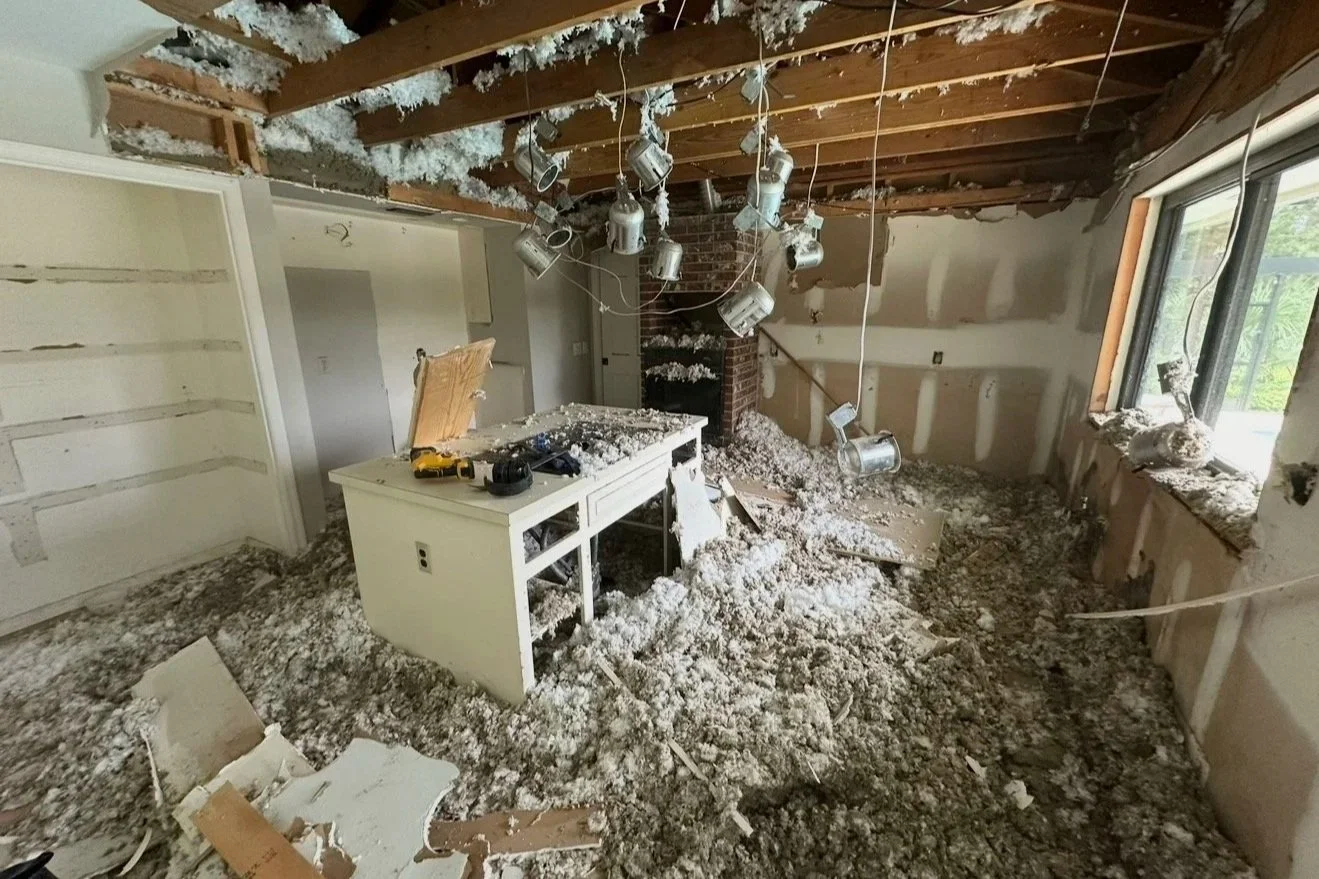
The first week is protecting the home, pulling the old kitchen out, and reframing whatever has to change. A kitchen opens onto the rest of the house, so dust travels in a way it does not in a closed-off bathroom. We set up containment first, then pull the appliances, cap the lines, and kill the circuits before anything comes down. Then we demo the cabinets, counters, backsplash, flooring, and whatever drywall has to open up. How deep the demo goes depends on the house. A lot of Central Florida homes are older, and some sit on a slab with no attic, which changes how the rough-in has to run after.
Week Two: Rough-In
Week two is the trades, and in a kitchen the electrical is the heavy one. A kitchen carries more circuits than any room in the house. The range, the microwave, the dishwasher, the disposal, the refrigerator, the small-appliance circuits along the counters, and all the lighting. The electrical alone can take a couple of days. On a full gut of an older home the electrical can run into five figures on its own, since so much of it is being torn out and replaced. The plumber moves what needs to move for the sink or an island. This is also where the HVAC crew moves or adds any A/C vents the new layout calls for. Gas is uncommon on Central Florida kitchens, since most of them run electric. If the range hood vents outside, the duct gets run now.
Week Three: Inspections
Week three is mostly inspections. The rough-in plumbing, electrical, mechanical, and framing all have to pass. The insulation goes in after those clear and gets inspected last, because once it is in it hides everything behind it. Nothing closes up until each one is signed off. Inspections run on the county's timeline, so there is some waiting built into this week, and we use it on work that does not depend on a sign-off, like painting the doors and trim before they go in.
Week Four: Closing the Walls
With the insulation signed off, the walls close. Drywall first, then paint. We do the drywall and the paint now, before the cabinets, on purpose. We want to set the cabinets against a finished, painted wall, not come back later and try to cut paint in behind a run of upper cabinets. Painting first is cleaner, it looks better where the cabinets meet the wall, and it is one less thing to fight at the end of the job.
Week Five: Paint, Then the Floor
The first half of the week finishes the paint. The second half is the floor. Here is a detail most people never think about, and it changes the order of the whole back half of the job: it depends on what your floor is made of. On tile, the floor goes in first and the cabinets sit on top of the tile. On LVP, it flips. We set the cabinets first and run the LVP around them, because you never set cabinets on top of a floating LVP floor. The plank needs room to expand and contract, and the weight of loaded cabinets pinning it down will buckle it over time. So the flooring you chose decides whether the cabinets go down before or after, and we plan that before we ever start.
Week Six: Cabinets, the Hood, and Measuring the Tops
Cabinets only take a day or two to set. Base cabinets first, leveled and shimmed dead flat, then the uppers. We install the range hood during this stage while we are already in the cabinets. Leveling matters, but not for the reason most people would guess. The countertops will sit fine even if the cabinets follow a crooked floor. Where an out-of-level run shows up is the backsplash. The bottom course of tile follows the top of the counter, so if that line is off, the grout lines taper and the tiles start to look like they grow across the run, and your eye goes straight to it. That is why we set the boxes dead level instead of letting them ride the floor. Once the cabinets are in, the countertops get measured for fabrication, and the trim work can start: the door casings, the baseboard, the crown, all of it.
One of the hardest parts of this week is cabinets that run to the ceiling. A ceiling is almost never truly level and flat, so the gap between the cabinet tops and the ceiling changes as it runs across the wall. The easy way out is to throw a piece of trim up there to cover it, but that almost never disappears. We can see the attempt, and so can the clients we build for. You can get away with about an eighth of an inch. Anything more than that and the eye catches it. So instead of hiding the gap, we fix it. We refloat the ceiling in those areas to bring it flat to the cabinets, which costs us time on this week but is the difference between a kitchen that looks built-in and one that looks close. We ran floor-to-ceiling cabinets down an entire wall on our Sweetwater Cove kitchen in Longwood, and on a run that long there is nowhere to hide an out-of-level ceiling, so every inch had to land right.
Week Seven: Countertops and Backsplash
After the measure, there is usually about a week while the tops are fabricated and brought back. This is the one real lag in the whole job, and the main reason a kitchen flexes between eight and ten weeks. With a fabricator who is not backed up you barely feel it. When the shop is slammed, this is where the extra week shows up. It is the only part of the timeline genuinely out of our hands, which is why we get the measurement scheduled as soon as the cabinets are set, to start that clock early. We keep moving on trim and detail work while we wait.
Setting the tops is a one-day job once they come in, and the backsplash goes in the same week. This is also where the minor touch-ups start and we shift our focus to the detail work.
Week Eight: The Trades Come Back
Now the electrician, the plumber, and the HVAC crew come back to trim out. Switches, receptacles, under-cabinet lights, the faucet, the dishwasher, the disposal, and the ventilation hookups. All the other appliances go in this week too, after the counters are set, since there was no reason to put them in earlier and risk them sitting in the middle of the work.
Week Nine: Final Inspections and Touch-Ups
The last week is the final inspections, the walkthrough, and the touch-ups. A typical kitchen lands right around here, at nine weeks. A clean, simple gut can come in closer to eight. Add a countertop backlog and you are at ten. That spread is almost entirely the one wait in the middle, not the hands-on work.
A Same-Layout Refresh: About Four Weeks
Not every kitchen is a full gut. When the layout stays exactly where it is, when we are not moving a sink or a wall, not adding appliances, just pulling and reinstalling the same refrigerator, microwave, and dishwasher on the connections that are already there, the whole job compresses to about four weeks.
It moves faster because the slow parts of a full gut are gone. There is no rough-in, no inspections gating the walls, and no waiting on a layout that has to be built before anything else. Here is how that month runs:
Week one: demo and drywall.
Week two: drywall and paint.
Week three: cabinets.
Week four: countertops, backsplash, and the finishing details.
There is one more reason this version is simpler. In most municipalities, simply pulling the old cabinets and tops and setting new ones in their place does not require a permit, because nothing structural, electrical, or plumbing is changing. That is not universal. The rules vary from one Central Florida city to the next, and we confirm it for your exact address before we start. If your city does require a permit for this scope, add about a week for that step, which puts the refresh closer to five weeks. Either way, skipping or shortening the permit and inspection cycle is a big part of why a refresh moves so much faster than a full remodel.
A refresh still waits on the same cabinet and countertop lead times up front, so the ordering happens just as early. The difference is all in the build.
A Kitchen Is the Hardest Room to Lose
Everything above is a rule of thumb, not a rigid script. A bathroom you can lose for a few weeks and still get by. A kitchen is the hardest room in the house to lose, which is why the smartest thing we do is schedule the whole remodel around your calendar before we ever start.
Once a kitchen is torn out, we cannot shuffle the work around and hand you a working stove for a weekend. The sequence runs in order, start to finish. So if there is a trip, a holiday, or anything else you need the kitchen for, we build the start date around it up front, rather than fight the calendar in the middle of the job when there is nothing we can do about it.
Inspections on a Kitchen
A full kitchen gut runs through a string of inspections, each one scheduled, passed, and cleared before the work it covers can move forward:
Underground plumbing, when drainage has to run under the slab, which a kitchen island often requires
Pre-slab, before the slab is poured back over the underground work, whether that is plumbing or electrical
Rough-in plumbing
Rough-in electrical
Rough-in mechanical, for the hood duct and ventilation
Roofing, when a vent boot is added or moved to a new spot on the roof
Framing
Insulation, which has to come after the rough-ins and framing pass, since it covers them
Final plumbing
Final electrical
Final mechanical
Final building
Not all of these apply on every job, and the exact list depends on the county, since we work across a lot of Central Florida jurisdictions and they do not all run it the same way. But the cadence is the same idea as any permitted job. Each inspection gates the next step, and that is part of why the calendar fills faster than the hands-on labor alone would suggest.
Why It Takes This Long
A kitchen takes eight to ten weeks because the work runs in order and each step depends on the one before it. Take a shortcut on any of it and you do not save time, you move the problem to the end of the job, where it is harder and more expensive to fix. Anyone promising a full gut in a couple of weeks is either skipping the parts you cannot see or has not counted the lead times that are coming either way.
The hardest delays are the ones nobody can plan around. We had a kitchen where the cabinets were fully custom, the kind you cannot just reorder from a catalog if something goes wrong. They were paid for and already in production, set to arrive a week before install, so we started the demo on that schedule. Then Hurricane Helene tore through the Carolinas where they were being built and devastated the area. The cabinets landed six weeks late. We had done everything right on our end, and it still got knocked off schedule by something nobody could control. That is just how it goes sometimes. Even when every step is done right, an outside event can move the date, and there is nothing to do but deal with it. The same thing hit the whole industry during Covid, when materials and cabinets that used to take weeks were suddenly months out. It does not happen often, but when it does, no amount of planning makes it disappear.
If You Have a Date in Mind, Work Backward From It
The single most useful thing you can do is start early. If you want your kitchen finished by a certain date, count back from it now. Hoping to host Thanksgiving in your new kitchen? You should be calling us no later than March. The sooner we sit down, the sooner the clock starts, and the more of that six-month window works in your favor instead of against you. When you are ready, reach out and we will get your estimate on the calendar.
How Long Does a Bathroom Remodel Take in Central Florida?
A guest bathroom remodel in Central Florida takes about four weeks, a primary six or seven. Here is where every week goes, from demo to glass.
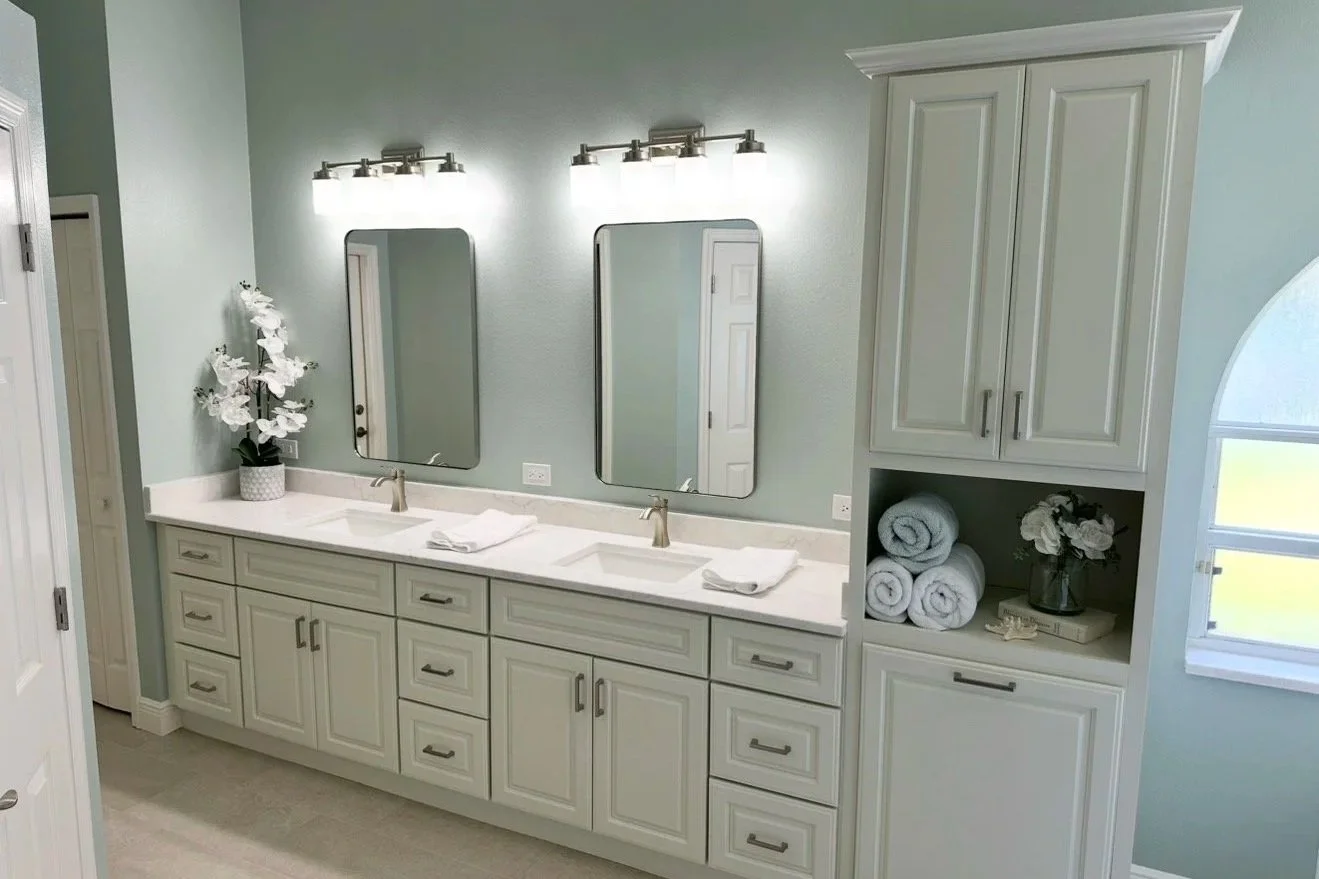
Primary bathroom remodel in Gatlin Woods, Orlando. This one ran about six weeks. With no drain to move we saved a week, but waiting on the countertops and building out the customized tower added it back.
A full guest bathroom remodel in Central Florida averages about four weeks. A primary bathroom can take up to six or seven weeks. I know that sounds crazy, so hang in there and read through this. Those are full gut timelines with permits, done the right way. The size of the room is not what sets the schedule. The work inside the walls and under the floor is, and that work has to happen in a specific order that cannot be rushed without it showing later.
We just finished a primary bath that ran the full six weeks with permits, and a guest bath in our experience runs closer to four. Here is where the time actually goes on both, and why the order matters as much as the days.
A Primary Bathroom: Six Weeks
Week One: Prep, Demo, and Framing
The first week is protecting the home, demoing the bathroom, and reframing whatever needs to change. How far the demo goes depends on the space, since some jobs come down to the studs and slab and others do not. Demo is not always the quick part people assume it is. Plaster walls can take days to bring down, and some old tile floors only come up in quarter-sized chunks, so a teardown that looks simple can eat more of the week than expected.
Framing comes next, and it is where a good job is either set up to succeed or quietly set up to fail. The walls have to be straight and the substrate has to be right long before anyone thinks about tile, because everything that comes later sits on what gets built now. We are already thinking about the finished product in week one. That is the part most people never see.
Week Two: Trades and Concrete
Week two is the trades. Electrical, plumbing, and mechanical all rough in during this stretch. And if the layout changed and we have to move a drain line, that one decision adds real time, because moving a drain means cutting the slab, running new underground plumbing, and pouring it back, with an inspection gating nearly every step. In the worst case that single change can run the better part of two weeks on its own. We lay out exactly what that looks like in the inspections section below.
None of this shows in the finished room. Nobody walks in and admires the rough-in work. Well, almost nobody. Some people love looking at this kind of work the way we do, and if you have read this far down the page, you are probably one of them. This is the week that decides whether the sconce placement works with the vanity and the mirrors, whether the shower drain is centered, whether the shower doors clear the fixtures instead of colliding with them, and a dozen smaller things like it. All of it has to be right before the tile goes in, not once it is on the wall, because once it is on, none of it moves without some deconstruction, and that is what we work to avoid. We do not always avoid it. Even with this much intentionality up front, you will always run into something on a project. How that something gets handled is what separates a good company from a bad one.
Week Three: Inspections and Closing the Walls
Before we can close up a single wall, the work behind it has to pass. The framing gets inspected and the insulation gets inspected, on top of the rough-in inspections from the trades. Only after the right ones pass do the walls close, and closing the walls means more than drywall. It includes setting the tile substrate in the wet areas, and in some counties that substrate gets its own inspection before any tile can go on.
These inspections are not a formality and they are not a delay. They are the checkpoint that confirms what is behind the wall is correct before it disappears.
Week Four: Tile
Week four is tile, and it is the most detail-heavy phase of the project. Not because it is the slowest, but because tile is the most unforgiving thing in the room that actually gets seen. The work inside the walls has to be right too, but it stays hidden. Tile is on display, so every cut, every line, and every shortcut taken upstream shows in the finished surface and stays there for good.
This is where the decisions made back in framing come home. If the tile backer was set right, tile goes on clean and the lines run true. If it was not, this is the week the problem surfaces. Fixing it falls on us, not on you. It costs us money, it costs the project time, and it costs you the frustration of watching work come back apart and wondering whether we know what we are doing. Good tile work is not just a skill at the end of the job. It is the payoff for getting the first three weeks right.
The moment the tile is in and true, we measure for the shower glass. Glass is cut to the finished tile, not to a drawing, so it cannot be ordered until the tile is set. And because it can take up to three weeks to manufacture, we measure it the day the tile is done to start that clock as early as possible, rather than waiting until the end and letting the lead time stretch the finish.
Week Five: Finishing the Drywall, After the Tile
This is the step that surprises people. The drywall went up when we closed the walls in week three. We will occasionally put a base coat of tape and mud on it, but we do not take the finishing any further, no floating it out, no sanding, no texture, until the tile is in. That runs against the order most crews use, and it is deliberate.
When the tile goes in, it always goes in straight, so the glass can be cut straight later. Then we float the drywall out to meet that tile, which makes crooked walls and small imperfections disappear into the finished surface. We do not always get to shift the framing, and we did not lay the original block walls that the furring strips attach to, so we are almost always building off of another contractor's work. You cannot always tell how far off a wall is from the start, so finishing to the tile is how we make the whole room read clean. We protect everything while we work back over it, covering the tile walls in plastic and the floors in ram-board. We have learned this the hard way. Finishing the drywall first and tiling second does not mean tearing the board back out. It means floating over it again, sanding again, texturing again, and repainting if the paint was already on. Doing it in that order just builds in a second round of finish work, so we flipped it.
Week Six: Installs, Detail Work, and Glass
The final week is the vanity, the fixtures, the trim, the detail work, and the glass. The glass was measured back when the tile went in, so by now the panels are manufactured and ready to set. Because that lead time can run up to three weeks, the glass is often the last piece to land and the one that completes the room. That is one more reason the front of the job has to be right. A wall that is out of square in week one becomes a glass panel that will not sit right at the end.
When a Primary Runs to Seven Weeks
Six weeks assumes a fairly standard finish. A primary can run into a seventh week when there are custom cabinets, because the cabinets have to be installed before we can measure for countertops, and the countertops then have to be fabricated and set. Until those counters are in, the mirrors and fixtures cannot go up either. So between the countertop fabrication and the shower glass, the last stretch can come down to waiting on outside vendors rather than on our crew. We measure both as early as the work allows to keep that wait as short as it can be.
A Guest Bathroom: Four Weeks
A guest bath is smaller and simpler, so the same work compresses. Demo and framing usually take a few days instead of most of a week, which means the plumber and electrician can start during week one. The trades finish and the inspections pass in week two. Tile in a smaller room is only a few days rather than a full week, so by the end of week three the tile is done and installs are already starting. Week four is finishing the installs and the detail work.
The finish sequencing does not change. The drywall is still floated out to the tile and finished afterward, just folded into those same four weeks. Shaving a day or two off each week on a smaller room does not sound like much, but across four weeks it is exactly what separates a four-week guest bath from a six-week primary.
Every Project Is Different
Everything above is a general rule of thumb, not a rigid script. The timelines hold for most full guts, but we plan each job around two things that change week to week: our crew's schedule and your life.
If our tile crew is tied up on another project and cannot be in two places at once, we may finish the drywall first and bring the tile in once they are free. If you have a vacation coming up or guests heading into town, we will switch around whatever can be switched to work with it. We look at every project and every client's situation on its own and build the plan that fits, rather than forcing the same calendar onto everyone.
Up to Twelve Inspections on a Single Bathroom
People are surprised that one bathroom can require this many sign-offs, but a full primary bath gut can run up to twelve separate inspections across the job:
Underground plumbing
Pre-slab
Rough-in plumbing
Rough-in electrical
Rough-in mechanical
Framing
Screw inspection on the tile substrate (where the county requires it)
Insulation
Final plumbing
Final electrical
Final mechanical
Final building
Not all of these apply everywhere. The screw inspection, for example, is not standard. Seminole County specifically requires it on the tile substrate, where the inspector confirms the backer product we chose is installed to the manufacturer's standards. And if the job has to vent out through the roof, you can add a roofing inspection on top of it. The exact list depends on the county, since we work across a lot of Central Florida jurisdictions and they do not all run it the same way.
Here is what that cadence looks like in real time. When a job requires moving a drain, the slab and underground work alone runs like this:
Day 1: Underground plumbing. Cut the slab and run the new drain.
Day 2: Underground plumbing inspection.
Day 3: Termite spray (soil treatment).
Day 4: Rebar and visqueen down to prep for the pour.
Day 5: Pre-slab inspection.
Day 6: Pour concrete.
Day 7: Plumbing rough-in, such as setting the shower liner on the new slab.
Day 8: Rough-in inspection.
That is eight working days on the underground and slab work alone, before a single wall closes, and it is the worst case. We work around the waiting where we can. While an inspection is pending we will paint doors and trim, and if an inspection passes in the morning we can often prep for the next step or pour the same afternoon and save a day. But the order itself cannot be skipped. You cannot pour over plumbing that has not been inspected, and you cannot rough in over a slab that has not been poured. The schedule moves one approved step at a time, and there is no significant way past that.
Each inspection has to be scheduled, passed, and cleared before the work it covers can move forward. That is why the calendar fills up faster than the hands-on labor alone would suggest. The hours of actual work are only part of the timeline. The other part is the inspection cadence, and that is not something a good contractor can or should try to rush.
Why It Takes This Long
It sounds like a lot of time for one room, and it is. But a proper full gut takes this much effort because the details do not arrive at the end of the job. They run through the whole thing, in order, and each one depends on the one before it. The framing has to be right so the tile backer is right. The tile backer has to be right so the tile is right. The tile has to be right so the glass fits. Pull any one of those out of sequence or rush it, and the problem does not stay where you cut the corner. It travels downstream and lands in the part of the room everyone can see.
Even doing everything right, the details chase you to the very last day. We recently finished a bathroom built on a block wall, the kind of wall we do not normally have to open up. Everything looked right. Then the vanity went in and we could see the drywall had bowed inward, leaving a quarter-inch gap across an eighteen-inch run behind it. We were already at the install stage with the paint done. So we pulled back, spent a couple of hours mudding, sanding, and re-texturing, and made it right. A crew promising a two-week turnaround would have run a bead of caulk across that gap and called it finished.
That is the honest answer to why a bathroom takes four to six weeks. A guest bath runs shorter because it is smaller and simpler. A primary runs up to six because there is more of everything, more trades, more tile, more detail, and more inspections gating each step. If someone quotes you a full gut on a fraction of that timeline, they are not faster. They are skipping steps, and the steps they skip are the ones inside the wall where you will never see them until something goes wrong.
We are a veteran-owned, state-certified contractor, and we would rather take the weeks and do it in the right order than hand you a room that looks finished and is not. The time is the work. The work is in the details. And the details start in week one and do not stop until the last panel of glass is set.
Kitchen Remodel in Dover Shores, Orlando
A dated Orlando kitchen taken down to the block and rebuilt from the wiring up: espresso cabinets, Calacatta Gold counters, two honest change orders, and a full breakdown of where the $116,000 went.
Finished Orlando kitchen remodel with espresso cabinets, Calacatta Gold counters, and stainless Bosch appliances.
This homeowner hired us for her kitchen because we had already remodeled her bathroom. It was a small job, just a guest bath, and she loved how it went. So when she was ready for something much bigger, she already knew who she wanted on it.
About a year after her bathroom, we posted the final photos of our Sweetwater Cove kitchen in Longwood, and she fell in love with it. She shot us a text right away, said she loved the cabinets, and wanted to talk pricing for her own.
What began as a dated, closed-in kitchen in Dover Shores ended as a clean, modern one. She did not want a face-lift. She wanted the whole thing redone, so we took it down to the masonry, rewired and replumbed it, and rebuilt it from there. All in, the project came to around $116,000, including her appliances.
What We Started With
The kitchen was dated and closed in. White cabinets with pink edging, pink laminate counters, white appliances, and a checkerboard vinyl floor. The layout used the space, but nothing in the room had been touched in decades, and it showed.
What she wanted was modern and bold, a kitchen that felt like hers while still paying homage to the home's original character. A surface refresh would not get her there. To do it right, everything had to come out.
Down to the Block
This is the part that never shows up in a finished photo, and it is the part that matters most.
A full gut was the only thing that made sense here. Once the soffits came out and the wiring and plumbing had to be rerun, doing anything less would have meant building a new kitchen around old problems instead of fixing them.
This is an older home with no attic. The ceiling is framed in 2x8s, which leaves only about seven and a half inches between the drywall and the roof. That tight space shaped almost everything that came next.
Electrical. We brought the whole kitchen up to code, which meant a full rewire. Code requires the new circuits to run all the way back to the panel rather than tying in along the way, and with no attic to route through, that meant opening the drywall all the way back to the panel to pull the new wiring. The kitchen electrical alone came to $12,406. Like we say in our kitchen cost guide, on an older home the electrical can pass $10,000 before a single cabinet goes in. [[LINK to your kitchen cost guide]]
Plumbing. We hooked up the new sink, installed the disposal, and ran new lines for the dishwasher. We also moved the refrigerator to a new spot, and since it had never had a water line, we added one. $2,268.
Ventilation. The old kitchen vented straight up through the middle of the ceiling. You can still see that vent in the before photo. A range hood has to vent near the wall, over the range, so we patched the old roof opening, cut a new one for the hood, and ran the duct, all threaded through that same seven and a half inches.
Then we insulated the exterior wall and hung and finished new drywall.
None of this is optional on a home this age. It is the difference between a kitchen that looks new and one that is new.
Being Real About Change Orders
Every honest remodel of an older home has change orders, and we would rather tell you why they happen than pretend they do not. This kitchen had two.
The first was the wiring. Once the walls were open, we saw how rough the old wiring really was. It was bad enough that we resized the wiring feeding the water heater, ran a new line for the washing machine, and ended up rewiring the laundry room on the other side of the kitchen. That came to $2,485. While we were in there, we also re-piped from the water heater for $710, so when the rest of the house is eventually repiped, the plumber ties into lines that are already new and the finished kitchen never has to be opened up again.
You cannot see any of this until the walls are open, and skipping it would have meant building a new kitchen on top of old wiring and old pipe.
The second was a choice, not a surprise. The homeowner upgraded her countertop to Calacatta Gold, a higher-end stone, and ran the backsplash full height in the same material. That pushed the stone cost up, and the overage came to $5,479. The right call, and it was hers to make.
Cabinets, Counters, and the Floor
With the walls closed back up, the new kitchen took shape.
Cabinets. Custom Bridgewood cabinets, solid cherry in their Scandia door, a flat slab front with clean, simple lines, finished in a deep espresso stain called Safari. They are frameless, built with no face frame, which is what gives the run that flush, modern look. $27,723. Stained wood cabinetry sits at the higher end, and it is one of the three things that move a kitchen budget the most.
Counters and backsplash. Calacatta Gold on the counters, with a full-height backsplash in the same stone running right up to the cabinets. Combined, the counters and backsplash came to $19,978. The full-height backsplash turns the wall into one clean surface instead of a counter with a separate tile band.
Floor. The home had its original terrazzo hiding under the kitchen's glue-down vinyl. We pulled up the old vinyl so it could come back, and the homeowner had the terrazzo refinished throughout the main living areas on her own, outside our scope. The kitchen above it went bold and modern, but the floor under it is original to the house. Bringing it back was the nod to where the home came from.
The Finished Kitchen
The finished kitchen is a different room. Bosch 800 Series stainless throughout, a 30-inch induction range, a counter-depth French-door refrigerator, and the quiet pocket-handle dishwasher, with an XO 30-inch chimney hood over the range. An undermount sink under the window, recessed lighting in place of the old fixture, and the full-height stone backsplash tying it all together.
Same footprint, completely different kitchen.
Where the Money Went
In our kitchen cost guide we say three things drive most of a kitchen budget: cabinets, electrical, and countertops. This project proves it. Together those three ran about $62,600, close to 60 percent of the contracted work. [[LINK to your kitchen cost guide]]
Cabinets: $27,723
Countertops and full-height backsplash: $19,978
Electrical: about $14,900, the rewire plus the corrections we found once the walls were open
Everything else, about $43,800, covered the rest of a full gut:
Permits, drawings, and admin: about $7,500
Demolition, framing, insulation, and drywall: about $11,600
Cabinet and appliance installation: about $8,600
Plumbing, including the water-heater repipe: about $3,000
Roofing and the new hood vent: about $3,500
Paint, doors, and trim: about $3,200
Materials, site protection, detailing, and cleanup: about $6,500
That brings the contracted job to about $106,000. With the homeowner's Bosch and XO appliances at roughly $10,000, the kitchen landed around $116,000 all in, the premium range we describe in the cost guide, $100,000 to $150,000.
This Project at a Glance
Location: Orlando, Florida
Project type: full kitchen remodel, single-family home, repeat client
Scope: full demolition, complete rewire up to code, new plumbing plus a replumb from the water heater, new hood vent, insulation, stained flat-panel cabinetry, Calacatta Gold counters and full-height backsplash, original terrazzo exposed, Bosch 800 Series and XO appliances
Timeline: about eight weeks from demo to finish, March to early May
Investment: around $116,000 all in, including homeowner-supplied appliances
Why It Costs What It Costs
Look back at where the money went and the pattern is clear. The cabinets, the stone, and the appliances are what you notice when you walk in. But a large share of the budget went into work you will never see again once the walls closed up: the rewire, the replumb, the new venting, the framing and drywall that had to come out and go back.
That is the honest answer to where our pricing comes from. On an older home, a full gut is the only way to fix what is wrong instead of building over it, and that hidden work is most of what you are paying for. A lower bid usually just means a smaller scope, and the difference tends to show up years later, behind the walls, where you cannot see it until it is a problem.
We would rather do it right and be straight about what it costs. If you are weighing a kitchen of your own and want a straight answer on what is really involved, [[CTA - soft, e.g. tell us about your home and we will walk you through it]].
What a Whole Home Remodel Cost in Central Florida
A whole home remodel in Central Florida runs $100 to $170 per square foot. Here is what separates the lower tier from the upper one, where your home fits, and what to budget before you start.
Kitchen and living space from a recent Apopka, Florida remodel, around $245,000.
A whole home remodel in Central Florida typically runs $100 to $170 per square foot. For a 2,000 square foot home, that puts a full remodel somewhere between $200,000 and $340,000, and most comprehensive projects should be budgeted at $240,000 and up. A 1,500 square foot home generally lands between $150,000 and $255,000, and a 2,500 square foot home runs roughly $250,000 to $425,000.
The range is wide because two houses of the same size can need very different work. To make it usable, it helps to split it into two tiers, which we cover below.
If you have already searched this question, you have probably seen much lower numbers, sometimes as low as $15 to $60 per square foot. Those figures describe something different. They cover light cosmetic updates spread thin across a house, with most of the square footage being bedrooms, hallways, and living areas that need little more than paint and flooring. A real whole home remodel is a different scope of work, and the price reflects that. The honest Central Florida range for a comprehensive remodel is $100 to $170 per square foot, which lines up with the mid-range full-remodel figures reported across Florida.
What a whole home remodel actually includes
When we scope a whole home remodel, we assess the entire house, not a room at a time. A typical project covers:
Every bathroom in the home
The kitchen
All flooring throughout the house
All new interior doors and trim
Full interior paint
That combination is what separates a whole home remodel from a series of single-room projects. Doing it as one coordinated job means the finishes carry through the whole house, the flooring runs continuously from room to room, and you live through one timeline instead of several. It also means decisions made in one room affect the others, which is exactly why the per-square-foot number is the most reliable way to budget for it.
Behind the finishes, a whole home remodel almost always involves significant electrical and plumbing work. Older Central Florida homes frequently need a new electrical panel to safely handle modern loads, and a full repipe is common when the original plumbing is near the end of its life or when the kitchen and bathrooms are being reworked anyway. This work runs inside walls and under floors, so it is easy to overlook when you are picturing the finished result, but it is a real part of the cost. It is also a real reason to do the whole house at once, because opening things up a single time for systems work is far more efficient than coming back to it later. A whole home remodel is always a permitted project, the same as any standalone kitchen or bathroom remodel, so permitting and inspections are a built-in part of the cost and the timeline.
The two tiers: $100 to $130 and $130 to $170 per square foot
The single biggest factor that decides which tier you land in is how much of the house has to be demolished and rebuilt, not just refinished.
The lower tier, roughly $100 to $130 per square foot, is what we hit when the house cooperates. Flooring is the clearest example. Many older Central Florida homes have a terrazzo floor, and you would never tear one out. You go over it. Going over sound terrazzo with LVP is straightforward, so the only floor demolition is the baseboard, and that keeps the flooring on the low end. Projects also land in this tier when the existing layout stays put, ceilings are standard height, finishes are solid mid-range, and cabinetry is limited to the kitchen and bathrooms.
The upper tier, roughly $130 to $170 per square foot, is where most comprehensive remodels actually land. The cost climbs when:
Hard flooring has to be dealt with. Demoing existing tile is labor-heavy, and in homes built before the 1980s the old tile and adhesive can contain asbestos, which turns removal into a permitted abatement job. Tiling over a terrazzo floor is no shortcut either, because prepping the polished surface so tile will bond is about as much work as demoing tile.
The layout changes. Moving or removing walls means relocating plumbing and electrical, and taking out a load-bearing wall brings in beams and engineering.
Ceilings are tall or vaulted. More wall and ceiling surface means more drywall, more paint, more involved lighting, and access equipment to reach it all.
The project adds cabinetry beyond the kitchen and baths. Laundry room cabinetry, built-in entertainment centers, mudroom storage, and feature walls are custom built and installed, not pulled off a shelf.
Finishes step up. Higher-end tile, countertops, fixtures, and flooring move the whole number.
One honest planning note. Even a basic full remodel of a 2,000 square foot home realistically starts around $240,000 once the entire core scope is in. The $100 per square foot figure is real, but it happens under the most favorable conditions, not as a default. If you are budgeting, plan toward the middle of the range and treat the low end as the exception.
How to tell which tier your home falls in
These numbers cover a wide range of houses, and the easiest way to place your own home in the range is to look at what homes cost per square foot to buy in your area. Across Central Florida in 2026, that runs from roughly $200 per square foot in many suburban neighborhoods up to $450 or $500 per square foot in premium areas like Winter Park, Windermere, and lakefront communities.
As a rough guide, a home around $200 per square foot tends to fall in the lower remodel tier, and a home around $500 per square foot tends to fall in the upper tier. This is not because we charge more to work on a more expensive house. The cost tracks the work, not the price tag on the home. Two things drive it.
First, finishes. Higher-end homes call for higher-end finishes, and more of them: more tile, more cabinetry, more detailed trim, better fixtures and countertops. Each of those choices adds cost, and they stack up across an entire house.
Second, the architecture itself. Premium homes often have features that change the labor involved, and ceiling height is the clearest example. Painting a home with standard ceilings is straightforward. Painting a home with 23 foot ceilings is a completely different animal, calling for scaffolding, specialized equipment, and far more time and material to cover the added wall and ceiling surface. Larger windows, elaborate trim, and more complex layouts work the same way.
So the price per square foot you paid for your home is a reasonable first clue to where your remodel will land in the range.
The flooring chain reaction most homeowners do not budget for
Flooring is where a lot of whole home budgets get surprised, because new flooring almost never stops at the flooring.
Start with the flooring itself. The cost has three parts, and breaking them out shows why the same size house can land at very different numbers:
Demoing existing tile: $6 to $10 per square foot. This is the labor-heavy line, and it is the one that disappears when a floor can be covered instead. Terrazzo is the case in point. You go over it rather than tear it out, and with LVP that drops this line entirely.
Materials: around $5 to $6 per square foot for quality LVP or porcelain tile. Solid wood runs higher, up to $20 per square foot or more, partly because glue-down wood needs an adhesive that costs around $200 per bucket.
Installation: about $7 per square foot for LVP. Tile runs $10 to $20 per square foot depending on size, material, and pattern, which is why tiled wet areas cost more per foot than the LVP running through the rest of the house.
Put together, replacing flooring with LVP throughout runs roughly $18 to $23 per square foot when the old floor has to come out. Cover a sound floor instead and the removal line drops, bringing LVP flooring closer to $13 per square foot. That single decision, remove or cover, is a real part of what separates the lower cost tier from the upper one.
New flooring throughout the house then triggers new baseboards throughout the house. Old baseboard rarely comes off clean when flooring is replaced, styles change over the years, and matching new floor to old, often paint-caked baseboard looks unfinished. Replacing the baseboard while the floors are open is the right call, and it needs to be in the budget from the start.
Then there are the doors. This catches people most often when they move from tile to luxury vinyl plank (LVP). Tile sits higher than LVP, so when the old tile comes out and thinner LVP goes in, the floor height drops. The door jambs and casing were originally cut to sit on top of the old tile. With a lower floor, that trim now floats above the new floor with a visible gap underneath, and it looks exactly as unfinished as it sounds. At that point you are either recutting and patching trim or replacing the doors outright.
In most whole home projects, full door replacement makes the most sense, and the reason is timing. If the whole interior is already being painted, the labor to remove, prep, and finish doors is already in motion. Adding new doors and trim to that pass is far more efficient than coming back to do it later, and it leaves you with clean, consistent doors throughout the house instead of original doors next to new floors and fresh paint. This is why doors and trim are part of our standard whole home scope rather than an upsell.
Where the kitchen and bathrooms fit
The kitchen and the bathrooms are the most expensive spaces in the house per square foot. They pack in plumbing, electrical, cabinetry, tile, and fixtures in a way the rest of the home does not, so they make up a large share of any whole home budget, and how you finish them is a big part of where you land in the range.
This post focuses on the whole home picture and the costs that run across the entire house, so we did not break those two rooms down here. We covered them separately. If you want to understand what drives the cost of a kitchen or a bathroom specifically, read our kitchen remodel cost guide and our bathroom remodel cost guide.
A real Central Florida example
We completed a remodel in Apopka that came close to a full whole home. The house is 2,600 square feet, and we redid the kitchen, one of its three bathrooms, all of the flooring, and the trim, and added some custom features. In today's dollars, a remodel like this runs around $245,000.
That lands below the per-square-foot range above, and the reason is scope, not size. We left two of the three bathrooms untouched, and bathrooms are some of the most expensive square footage in any house. Taking two of them off the table pulled the cost below what a full whole home, with every bath done, would run. It is a clean example of how scope drives the number more than square footage does.
You can see the kitchen, the bathroom we remodeled, the laundry room, the living space, and the trim work in our Apopka whole home remodel gallery.
One corner worth watching for
If you are comparing quotes, here is a question worth asking: will the contractor lay new flooring over your old floor? The answer should almost always be no. A new floor installed over an old one cannot be guaranteed, and when it fails it takes the trim, the cabinets, and the fresh paint with it. The only place going over an existing floor makes sense is LVP over sound terrazzo.
A contractor who agrees to cut that corner will usually cut others. The work looks fine at the reveal and starts coming apart a few years later. That is worth paying attention to when you compare bids.
Planning your own whole home remodel
The most useful thing you can do before you start is decide on scope honestly. A whole home remodel at $100 to $170 per square foot assumes you are doing the whole home: every bath, the kitchen, all the flooring, all the doors and trim, and full paint, with demo, layout changes, tall ceilings, and added cabinetry pushing toward the higher end. If your project is smaller than that, your per-square-foot number will be different, and you should be wary of any contractor who quotes a whole home price without walking your actual house first.
Collins Kitchen and Bath is a veteran owned, Florida state certified remodeling contractor (CBC1268306) serving Central Florida since 2016. We focus on single family homes, and we are happy to walk your house, talk through scope, and give you a real number based on what you actually want to do.
If you are thinking through a whole home remodel in Apopka, Orlando, Windermere, Winter Garden, or anywhere in Central Florida, reach out and we will help you build a plan that fits.
What Drives Up The Cost Of A Kitchen Remodel In Central Florida
A real breakdown of what a kitchen remodel costs in Central Florida, from a $50,000 basic build to a $250,000 luxury kitchen, and where every dollar goes.
A premium Sweetwater Cove kitchen in Longwood, finished in cherry flat-slab cabinetry. This one ran around $120,000, and here is what drives a number like that.
A full kitchen remodel in Central Florida spans a wide range. A basic full kitchen runs $50,000 to $70,000. A premium kitchen typically lands between $100,000 and $150,000. At the top end, a luxury kitchen with custom cabinetry and features like backlit countertops can reach $150,000 to $250,000. The range is wide because three things drive most of the cost in any kitchen: countertops, electrical, and cabinets.
This guide breaks down where the money actually goes and the factors specific to Central Florida homes that homeowners rarely hear about until a contractor is already standing in their kitchen. Collins Kitchen and Bath is a veteran-owned, state-certified contractor, and these numbers reflect real kitchens we have built across Orlando, Winter Park, Windermere, and the surrounding cities.
The three decisions that move your kitchen budget the most
If you want to understand your kitchen cost before you ever get a quote, look at three things first. They account for most of the difference between one kitchen and the next.
Countertops. Countertops set the tone of the kitchen and they carry real weight in the budget. Quartz has become the default for Central Florida kitchens because it is durable, low maintenance, and handles our humidity well. Granite and natural marble carry their own pricing and upkeep tradeoffs.
Beyond the material itself, edge details add up. A mitered edge, where the stone and a matching piece are cut at a 45-degree angle and joined at the corner, makes a standard slab read as a thick, solid block and lets the veining wrap seamlessly around the corner. It takes far more cutting and fabrication time than a simple edge, so it adds real cost. A waterfall edge takes that further, running the stone down the side of an island to the floor.
Slab count is the clearest way to see how this adds up. A large island might take a single slab, but an island with a waterfall on each side, cut to hold the best book match so the veining mirrors cleanly across the seams, can eat up two entire slabs on its own. The leftover pieces may serve other areas of the kitchen, but the slabs still have to be bought. We have done kitchens that used a single slab and kitchens that used four.
Electrical. This is the cost that surprises homeowners the most. Many of the homes we work on require a full rewire, and current code often requires that circuits be run all the way back to the panel rather than tied in along the way. With a licensed electrician running $100 to $150 an hour plus materials, a kitchen's electrical scope can pass $10,000 on its own before a single cabinet goes in.
Older homes are where this hits hardest. In houses built in the 1960s or earlier we routinely find wire with insulation that has gone brittle and crumbled after decades of age and heat, along with conductors that rodents have partially chewed through. That wiring is not safe to build a new kitchen on top of, so the idea of a budget remodel on a home that old is rarely realistic. If your kitchen needs updated wiring to meet code, the work is not optional, and it belongs in your budget from day one.
Cabinets. Cabinets have the widest price range of anything in the kitchen, which is why they swing budgets so dramatically. White shaker style cabinets can be purchased for under $10,000. Stained wood cabinetry, on the other hand, often runs $30,000 to $40,000 for the same kitchen. The door style, the wood species, the finish, and the construction of the box all factor in. In our humid climate, plywood box construction resists moisture far better than particleboard, which can swell and break down over years of Central Florida humidity. The cabinet decision alone can move your total by tens of thousands of dollars.
What brings a kitchen cost down
The single biggest way to control cost is to keep the kitchen in its existing footprint. The moment you remove a wall, relocate appliances, or upgrade to larger appliances that need new connections, the project changes character and the price climbs. A basic full kitchen that keeps the same appliances in their existing locations, with simple permitting, new cabinets, drywall, countertops, and a backsplash in basic materials, can be done for $50,000 to $70,000. That is about as basic as a full kitchen gets at our level of work.
You can narrow scope further still and put every dollar where it shows. The Lake Cawood kitchen we did in Windermere is a good example. We completely replaced the island cabinets with premium white oak and gave the island a double waterfall, where the countertop stone cascades down both ends to the floor. The edges throughout were mitered, on the island and the perimeter alike, so the stone reads as a thick, solid block with the veining wrapping seamlessly around each corner.
Everywhere else, we kept what worked. The existing white shaker cabinets stayed, and we replaced the tops and the backsplash and swapped in new pendant lights. The dishwasher was reused, the refrigerator and oven were never touched, and we kept the existing gas cooktop. Nearly all of the budget went to the countertops, the island cabinets, and the pendant lights. That focus brought the project in around $45,000 and turned a beautiful kitchen into a breathtaking one without rebuilding the entire room.
The honest takeaway is this. If your current layout works and you simply want the kitchen to look and function better, you can put your budget into the finishes that matter and get a strong result. If the layout genuinely does not work, the change can be worth every dollar. The mistake is moving things for small reasons and absorbing a large cost you did not plan for.
A realistic breakdown by scope
Here is how kitchen projects tend to sort out in Central Florida. Your actual number depends on the size of your kitchen, the condition of what is behind the walls, and your finish selections.
Basic full kitchen, $50,000 to $70,000. This keeps the same appliances in their existing locations. Simple permitting, new cabinets, drywall, countertops, and a backsplash, all in basic materials with no waterfall edges or upgraded extras. About as basic as a full kitchen gets.
Mid-range full kitchen, $70,000 to $100,000. A step up in materials and detail while still keeping the layout. Better cabinetry, quartz countertops with a mitered or single waterfall edge, updated lighting and fixtures, electrical brought to code, and room for a few new appliances. This is the tier for homeowners who want a clearly elevated kitchen without going fully custom.
Premium kitchen, $100,000 to $150,000. A full remodel done to a premium standard. Quality cabinetry, premium countertops, electrical brought to code, and new fixtures and lighting with a finish level that holds up over time. Stained wood cabinetry, which alone can run $30,000 to $40,000, lives here. The upper end of this range covers larger footprints, layout changes, and expanded islands.
Luxury kitchen, $150,000 to $250,000. Fully custom cabinetry, top-tier materials, and statement features. This is the tier for backlit countertops and Cristallo quartzite, a translucent natural stone that glows from within when lit from behind. At this level the kitchen becomes the architectural centerpiece of the home.
The Central Florida factors most guides skip
A few realities of remodeling in our area affect both cost and timeline, and they are worth knowing before you start.
Permitting is about time, not just fees. Getting a permit is rarely the obstacle here. Where permitting gets expensive is the contractor's time. On a typical kitchen we spend around 40 hours managing the process, which includes meeting with an architect, filing all the paperwork, and meeting with inspectors. A kitchen project usually involves around 10 inspections. Sometimes that means an employee waiting on site for an inspector who arrives on their own schedule. We schedule inspections alongside other work whenever possible to keep that time from being wasted, but the labor behind permitting is real and it belongs in the cost of the job.
Slab construction makes layout changes a bigger job. Most Central Florida homes sit on a concrete slab, and the kitchen plumbing runs through it. Moving a sink, a dishwasher, or an island to a new spot means cutting and jackhammering the slab to reroute the pipes, then patching it back. None of this is a problem for an experienced crew, but it is real labor and real dust, and it is a large part of why a layout change costs what it does.
A remodel is the right time to plumb the kitchen for the future. Most homeowners never think about this, but if the house has not been repiped, a full kitchen remodel is the moment to get ahead of it. We can run new water lines from the water heater up through the attic and down into the kitchen. Then, when the rest of the home is eventually repiped, the plumber ties into lines that are already new, and the finished kitchen never has to be opened up again.
Hidden conditions surface at demolition. Older homes keep their surprises behind the walls and under the cabinets. Once demolition starts we sometimes find dated plumbing, moisture-damaged drywall, or a floor that has settled and needs leveling before new cabinets will sit right. A good contractor plans for the likelihood of a few discoveries rather than pretending a decades-old house will open up clean.
Lead times drive the schedule. Custom cabinets and premium stone are ordered, not pulled off a shelf, and they can take weeks or months to arrive. On a higher-end kitchen the timeline is set as much by when materials land as by how fast a crew works. Ordering early, before demolition begins, is what keeps a project from stalling partway through.
How to get an accurate number for your kitchen
The ranges in this guide are useful for planning, but the only way to know what your specific kitchen will cost is a walkthrough. The variables that matter most are your kitchen's size, the condition of the wiring and what is behind the walls, whether you are keeping the layout, and the finish level you want. A contractor who quotes a precise price over the phone without seeing the space is guessing, and the gap between a guess and reality usually shows up halfway through the project.
When you are ready to plan a kitchen remodel in Central Florida, the most useful first step is a conversation about what you want the kitchen to do, not just how it should look. The function drives the layout, the layout drives the budget, and the budget drives the finishes. Get that order right and the whole project gets easier.
What Drives Up the Cost of a Bathroom Remodel in Central Florida
Bathroom remodel costs in Central Florida start around $25,000 for a guest bath and $40,000 for a primary. Here's what actually drives the price up.
Primary bathroom remodel completed in Winter Garden, FL. Total project cost: approximately $42,000.
Bathroom remodel costs in Central Florida vary widely, but most homeowners are surprised at the answer. A guest bathroom remodel typically starts around $25,000, while a primary (master) bathroom starts around $40,000. The price difference between the two isn't proportional to the size difference, and that's the part most homeowners don't expect.
The three biggest cost drivers in any bathroom remodel are tile, electrical, and plumbing. Within those three, the specific decisions you make about layout, shower design, and material selection have a bigger impact on the final price than most homeowners realize. A small layout change can add thousands. A different shower design can save thousands.
This guide breaks down what actually drives bathroom remodel cost in Central Florida, including the specific decisions that push the budget higher, the counterintuitive truths that most homeowners get wrong, and the foundational baseline that applies to every project no matter the size.
The Big Three Cost Drivers
Tile, electrical, and plumbing are the three biggest factors in bathroom remodel cost. Each one is influenced by specific decisions, and small changes in those decisions can swing the budget by thousands.
Tile is priced by the square foot, and the shape of the space changes the cost more than most homeowners realize. The amount of tile, the type of tile, the labor to install it, and the backer board behind it all add up.
Electrical work is foundational on every bathroom remodel. New circuits, updated outlets, GFCI protection, vanity lighting, overhead lighting, and exhaust fan wiring all happen as part of the standard scope. Costs go up when you add features like sconce lighting, recessed lighting in multiple zones, or in-shower lighting. Every added fixture adds wiring, labor, and material cost.
Plumbing is where layout decisions can blow a budget fast. Keeping fixtures in their existing locations is one of the most cost-effective decisions a homeowner can make. Moving them is where the cost climbs quickly, which we'll cover in the next section.
Why Layout Changes Are Budget Killers
Layout changes are the single biggest reason a bathroom remodel goes over budget. In a small bathroom, layout changes are almost impossible to make without expanding into another room, which is rarely worth doing when you factor in the additional cost and the ROI impact.
Even in a primary bath where there's more room to work with, moving fixtures triggers a cascade of additional work.
Moving plumbing in a slab home (which is most homes in Central Florida) involves:
Cutting concrete to access the drain lines
Rerouting drain and water supply lines
Pouring concrete back after the new lines are in
Additional inspections for the plumbing work
Verifying the new location meets Florida Building Code requirements for vent stack distance
That last point catches a lot of homeowners off guard. Florida Building Code requires plumbing fixtures to be within a specific distance of a vent stack. Moving a toilet, sink, or shower beyond that distance means a new vent stack has to be run, which adds significant cost on top of the plumbing relocation itself.
Raised homes are different. Moving plumbing in a home with a crawl space underneath is much less involved because there's no concrete to cut and pour back. The drain and water lines can be accessed and rerouted from below. The cost difference between moving plumbing in a slab home versus a raised home is substantial.
A note on ROI. If you're planning to sell your home within the next few years, layout changes that drive up cost rarely pay back in resale value. If this is your forever home, ROI doesn't matter and you should make the layout work the way you want it to. Knowing which situation applies to you helps make these decisions clearer.
Shower Design, Tile, and Why More Glass Can Be Cheaper
Shower design is where the counterintuitive truths come out. Most homeowners equate open glass showers with luxury, and luxury with higher pricing. It's an understandable assumption, but it doesn't match how shower cost actually works.
Tile work is priced by the square foot. The more tile you have, the more you pay in three places: tile material, tile backer board, and tile labor. Tile labor is the biggest of these three. Tile labor also costs more than glass labor, which is the key fact most homeowners don't know.
So while an open, glass-heavy shower reads as luxurious, it's often the more cost-effective design. More glass means less tile, less backer board, and less labor on the most expensive part of the shower build.
Two-wall shower with glass: Less expensive. Less tile, less backer board, less labor on the tile side. The glass installation adds cost but less than the tile it's replacing.
Three-wall shower with glass: More expensive. More tile, more backer board, more tile labor. The glass enclosure cost doesn't scale much with size because most of the cost is in the hardware and labor, not the glass material itself. Whether the enclosure has one panel or three, the hinges, brackets, door hardware, and installation labor are similar. Adding more square footage of glass adds some material cost but doesn't multiply the way more square footage of tile does.
Corner shower: Often the most cost-effective design because you have two glass walls and only two tile walls. Most homeowners want a corner shower for the open feel without realizing it's actually the budget-friendly choice.
Other features inside the shower also drive cost up:
Benches add labor and materials. The framing, waterproofing, and tile work on the bench surface and edges all add cost.
Niches add labor and material per niche. The waterproofing detail around a niche is more involved than a flat wall, and each niche adds tile work for the back, sides, and trim.
These features can swing tile labor on a single shower from around $5,000 to $8,000, with similar swings on the material side. A "simple shower with a couple of nice features" can quickly become a 50% increase in tile cost compared to a flat shower with no add-ons.
Tile pattern and size also affect labor cost. Standard straight-set tile is the baseline, and 12x24 tile is the sweet spot for most floors and shower walls. It's large enough to cover ground quickly without being so big that handling and setting it becomes difficult. Smaller format tiles like 6x6 or mosaics cost more in labor because there's more grout work per square foot. Larger format tiles over 24 inches cost more in labor because they're heavier, harder to set perfectly flat, and require more precise substrate preparation.
Patterns add cost too. Herringbone, diamond patterns, and other angled or geometric layouts cost more per square foot in labor because each piece requires more cutting and more precise placement. That said, the pattern is often what makes a bathroom feel custom and high-end. If a herringbone shower floor is the visual you want, the labor upgrade can be worth it for the impact. Standard layout if you want to save, pattern if the look matters more than the budget on that surface.
Tile material matters too. Ceramic and porcelain are both clay-based tiles, but porcelain is fired at higher temperatures, which makes it denser, harder, and more water-resistant. Ceramic absorbs more moisture and is more prone to cracking under impact, which is why it's not the right choice for shower walls or floors that see heavy daily use.
Natural stone tile (marble, quartzite, travertine) is the highest-end material category. The stone itself costs more to source, and the installation involves additional steps like sealing before grouting, careful cutting to preserve veining, and specialized handling to prevent chipping. It's not that the installation is harder, it's that there's more work involved per square foot.
Glass tile is significantly more expensive than porcelain or ceramic, both in material cost and labor.
Other Cost Drivers Worth Knowing About
Beyond the cost drivers already covered, a few other decisions push the budget up.
Cabinet packages vs off-the-shelf vanities. This is one of the biggest swings you can make on a bathroom remodel budget. Off-the-shelf vanities cost about 30% of what a cabinet package costs. The reason is in the build. An off-the-shelf vanity comes pre-built with the cabinet, top, and sink integrated, which makes it a plug-and-play install. A cabinet package, on the other hand, requires purchasing a separate countertop slab, having it fabricated to fit, and a separate countertop install where the sink is set as part of that work. The cabinet itself also takes longer to assemble and install than a pre-built vanity. If you're trying to control budget on a bathroom remodel, choosing an off-the-shelf vanity over a custom cabinet package is one of the biggest cost-saving decisions available.
Lighting fixtures. Lighting is one of the biggest variable cost categories in a bathroom. A basic vanity light fixture can be $100. A high-end designer fixture can be $1,500 or more. Multiply that across vanity lights, overhead fixtures, sconce lighting, and any accent fixtures and the lighting selection alone can swing a project budget by thousands. Lighting is where homeowners have the most room to flex up or down based on budget priorities.
Plumbing fixtures. Faucets, showerheads, valves, and trim are where we recommend not trying to save. Cheap plumbing fixtures fail. The internal cartridges, valves, and washers in budget faucets and shower trims don't hold up under daily use, and replacing a failed in-wall valve later means opening up tile work to get to it. Spending more on plumbing fixtures up front means fewer service calls, fewer warranty headaches, and no risk of having to demo tile to replace a $40 valve five years from now.
Why Even a Guest Bath Starts at $25,000
One of the most common questions we hear is: "It's just a small bathroom. Why does it cost $25,000?"
The answer is foundational cost. Every bathroom remodel, regardless of size, requires the same core scopes of work:
Permitting and inspections
Demolition of existing finishes, fixtures, and sometimes framing
Plumbing work
Electrical work
Framing adjustments where needed
Drywall installation and finishing
Tile installation
Cabinetry installation
Countertop installation
Final fixture installation and trim work
A 35-square-foot guest bath touches every one of these scopes. A 120-square-foot primary bath touches the same scopes. The primary bath has more tile to install, more cabinetry, and more fixtures, but the foundational work is identical.
Homeowners often assume that a bathroom one-quarter the size should cost one-quarter as much. The math doesn't work that way. A small bathroom still needs a plumber, an electrician, a tile setter, and a permit. Those costs don't drop just because the room is smaller.
Budget Benchmarks
If you're starting to plan a bathroom remodel, here are the Central Florida pricing benchmarks for our work:
Guest bathroom remodel: Starting around $25,000
Primary bathroom remodel: Starting around $40,000
High-end bathroom remodels: $60,000 to $100,000+ depending on structural changes, premium materials, and custom features
How Collins Kitchen and Bath Approaches Bathroom Remodel Pricing
At Collins Kitchen and Bath, every estimate is broken down line by line. You'll see exactly what each part of the project costs: permitting, demolition, framing, drywall, electrical, plumbing, tile installation, cabinetry, countertops, basic lighting, and labor. This level of detail means you can see where the money is going and make informed decisions about scope adjustments.
If you're planning a bathroom remodel anywhere in Central Florida, we offer free in-home consultations. You can see our full service area on our Service Areas Page. We'll walk through the space, talk through your goals and budget, and give you an honest assessment of what's possible within your scope.