Quartz, Natural Stone, or Porcelain: How to Choose the Right Countertop
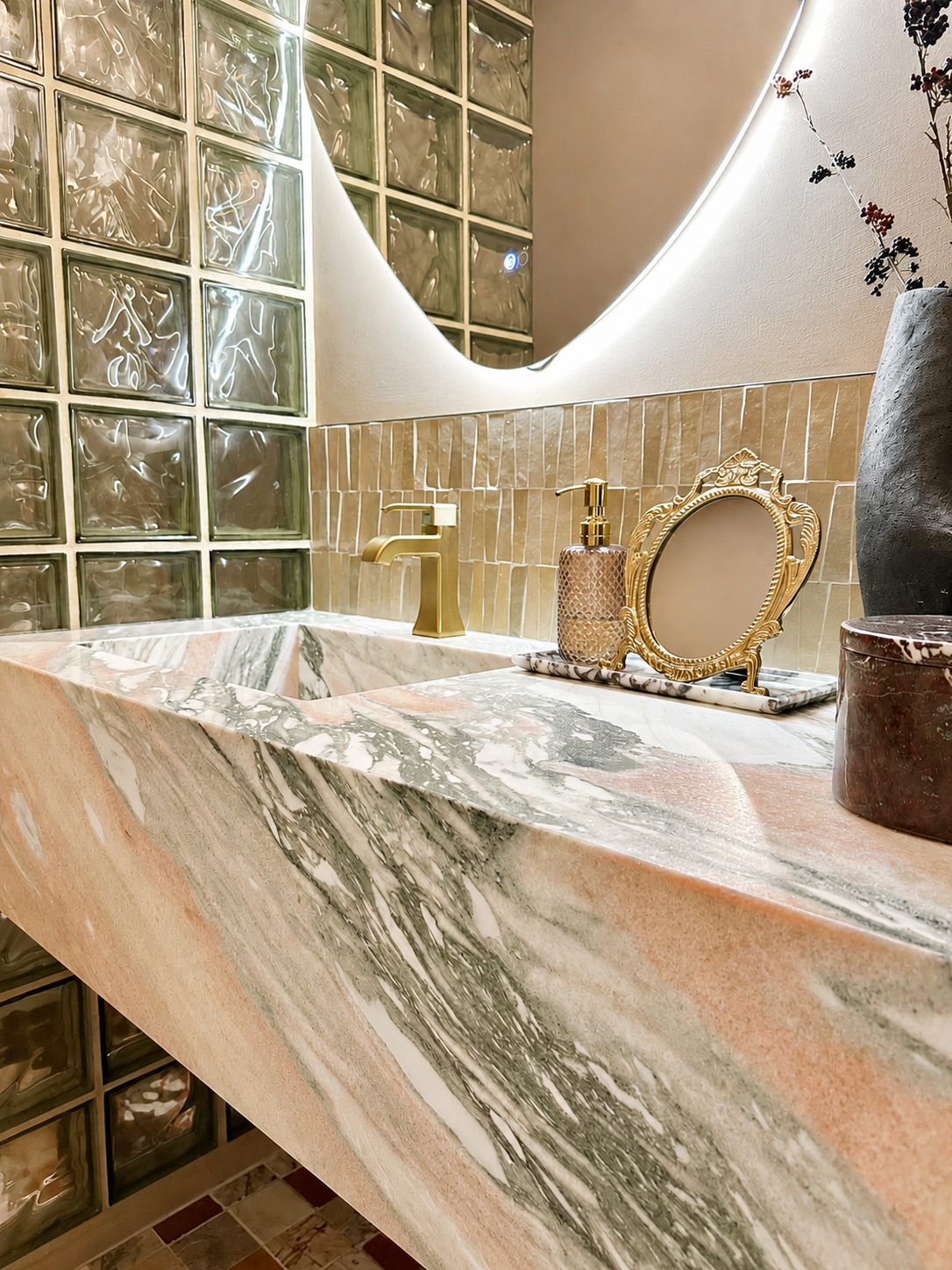
A floating red marble vanity with an integrated sink in a Winter Park powder bath
The countertop is the surface you touch every day and the one your eye lands on the moment you walk into a kitchen. It carries the look of the room and takes the daily beating of cooking, cleaning, and life happening on top of it. Most homeowners come to us knowing they want stone but not knowing which kind, and the ones that come up most are quartz, granite, marble, and porcelain. Each one behaves differently, and the right answer depends on how you live and what you want the room to feel like.
The names do not help. Quartz and quartzite are two different products that sound like the same word. Half the slabs sold as one thing get called the other on a showroom floor. So before anything else, here is the line that sorts the whole category: some of these surfaces are cut out of the ground, and one of them is manufactured. That single split explains almost every difference that follows.
Quartz: The Everyday Workhorse
Quartz is the manufactured one. It is engineered stone, made from ground natural quartz mineral bound with resin and pigment. Cambria, the line we use most, is 93 percent quartz and 7 percent binder and pigment, which is typical for the category. The material is real and it is mined on purpose. Cambria runs its own quartz mine and presses every slab at a single plant in Minnesota. The color and pattern run through the slab rather than sitting on top of it.
It is the surface most of our clients land on, and for most rooms in most houses it is the right call.
It is non-porous. That is the headline. It never needs sealing, it does not stain, and nothing gets into the surface. Soap and water and you are done. The pattern range runs from clean whites with soft veining to bold movement that reads like marble, and it takes almost any edge profile you want. Because it is manufactured, the slab that shows up looks like the sample you picked. There is no surprise waiting on the truck.
The trade-off is heat. Quartz holds up to roughly three hundred degrees. Past that it is the binder that fails, not the stone, and it shows up as discoloration or a scorch mark that does not come out. A pan straight off the burner will do it. If you cook hard and you are the kind of cook who sets the pan down before you go looking for the trivet, take that seriously.
That same binder is why quartz stays indoors. Prolonged sun yellows it. A long run of counter under a south-facing window can fade over years, and an outdoor kitchen will cook it.
For a kitchen where the trivets get used, a laundry room, or a primary bath, quartz is hard to beat.
Granite: Built For Heat And Sun
Granite is the one people ask about most in the same breath as quartz, and the two are not close relatives. Granite is igneous rock, cooled from magma and cut straight from the quarry. Every slab is one of a kind. What you approve at the yard is what goes in your kitchen, veining and all.
Granite beats quartz in two specific places, and they are not small.
Heat is the first. Granite handles temperatures in the range of twelve hundred degrees. There is no binder in it to scorch. You still want a trivet, because sudden temperature change can shock any stone, but the everyday reality is that granite forgives the hot pan and quartz does not. For a serious cook, that is the whole argument.
Sun is the second. Granite does not yellow or fade. It belongs outside as comfortably as it belongs inside, which matters in Florida for outdoor kitchens and for any run of counter that catches hard afternoon light.
The trade-off is that granite is porous and needs sealing. This gets oversold. How often depends entirely on the slab, and the range runs from about one year to five. A dense, dark granite can go five years or more. A light, thirsty one wants it more often. You can check it yourself in fifteen minutes with a puddle of water. If it beads, you are fine. If it soaks in and leaves a dark ring, it is time. The work itself is a wipe-on product and an afternoon.
Granite also has natural fissures, which is why it can chip at an edge where quartz would not. That is the real cost of a stone that was made by the earth instead of a press.
If you cook hard, if the counter sees sun, or if you want a surface nobody else has, granite is the answer.
Marble: Beauty That Keeps A Record
Marble is not a performance decision. It is a decision about what you want the room to feel like, and it asks something of you in return.
Marble is soft, it is porous, and it etches. Etching is the part people misunderstand. It is not a stain and sealing does not stop it. Acid touches the surface, lemon or wine or vinegar or tomato, and it eats a dull spot into the polish on contact. A sealer protects against staining. Nothing protects against etching, because etching is a chemical reaction with the stone itself.
That sounds like a disqualifier. It is not, and here is why people keep choosing it anyway. Marble does not fail. It records. The etch marks and the softening of the polish become a patina over years, and a marble counter at year ten looks lived in rather than worn out. Bakers have used marble slabs for centuries because it stays cold and it is the right surface for pastry.
The finish you pick decides how much of that you see. A polished marble is bright and reflective and shows every etch as a dull spot against the shine. A honed marble is already matte, so the same etching barely reads. For a kitchen where somebody actually cooks, honed is the forgiving choice. Polished belongs on a backsplash or a vanity or a baking station, somewhere the acid does not land.
The powder bath featured on this post is built around a floating red marble vanity with an integrated sink carved from the same stone. A powder bath is the easiest place in the house to say yes to marble. Nobody is cutting limes in there. You get the whole effect and almost none of the risk.
Choose marble if you want the look and you have made peace with the patina. Do not choose it hoping it will stay perfect, because it will not, and that is the point of it.
Porcelain: Built For Heat And Feature Walls
Porcelain is the newest of the four to gain ground, and it earns its place in specific spots. It is fired clay with the pattern printed on the surface, which gives it two stand-out traits. It is UV stable and it laughs at heat, which makes it a strong call for an outdoor kitchen where quartz would fade and discolor.
It also comes in large thin slabs that suit dramatic feature walls and full-height fireplace surrounds, and it is showing up more and more on kitchen counters as homeowners discover it.
A couple of things to understand before you choose it. Because the pattern is printed on top, a deep chip on an edge can reveal the plain clay body underneath, and porcelain is brittle, so it wants careful handling.
The slab itself is not necessarily cheaper than quartz. The cost lives in the labor. Porcelain has to be cut slowly with specialized blades, and the mitered edges that give a thin slab the look of a thick one take time and skill to execute cleanly. That fabrication is where a porcelain top earns its premium.
Beyond The Big Four: Quartzite, Onyx, And Exotic Stone
Past those four sits a tier of stone where the countertop stops being a work surface and becomes the reason you remember the room.
Quartzite is the one worth knowing first, and it is where most of the name confusion in this whole category comes from. Quartzite is natural stone, cut from the quarry like granite. It started as sandstone and was compressed and heated under enormous pressure until the grains fused into solid rock. It is made largely of the same quartz mineral that goes into engineered quartz, which is exactly why the two get mixed up, but it is not the same product and it does not behave like one. Quartzite performs the way granite performs. It takes heat, it stands up to sun, it needs sealing, and every slab is unique. What sets it apart is the look. Quartzite tends to run whiter and brighter with veining that reads like marble, which is why it costs what it costs. If you want the look of marble and the toughness of granite, quartzite is the stone that does both.
Onyx and the translucent stones open a door the others do not. Light passes through them. Run a light source behind the slab and the veining glows from inside the stone. Onyx and the lighter crystalline quartzites are the ones that do this best, and a backlit island or feature panel becomes the centerpiece of the room. These are soft stones and they ask for a gentle hand, which is why they belong on a vertical panel or a bar top rather than under a knife.
The exotic marbles carry the same drama through color instead of light, from soft pinks to deep veined reds that hold a whole room on their own.
How To Choose
So how do you choose.
If you want a durable, low-maintenance surface that handles daily life and comes in nearly any look, quartz is the smart default for most rooms in the house. Use the trivets.
If you cook hard, if the counter takes sun, or if you want a slab nobody else has, granite. The sealing is less work than it sounds and the heat tolerance is real.
If you want marble and you understand that it will keep a record of your life, marble, honed if it is a working kitchen.
If you are building an outdoor kitchen, a feature wall, or a fireplace surround, porcelain is built for exactly that.
And if you want the look of marble without the worry, or you are chasing a showpiece like a backlit island, quartzite and the exotics are worth the reach.
The best surface is the one matched to how you use the room. That is the conversation we walk every client through before a single slab is ordered.
Frequently Asked Questions
What is the difference between granite and quartz?
Granite is natural stone cut from the quarry. Quartz is a manufactured product made from ground quartz mineral bound with resin, typically around ninety percent stone. The practical differences are heat and sealing. Granite handles far more heat and can take direct sun, but it is porous and needs periodic sealing. Quartz never needs sealing and will not stain, but the binder in it can scorch above roughly three hundred degrees and can yellow in prolonged sun.
Are granite and quartzite the same thing?
No, but they are close cousins. Both are natural stone cut from the quarry, both take heat, and both need periodic sealing. They are different rocks. Granite is igneous, formed from cooled magma. Quartzite began as sandstone and was compressed and heated under enormous pressure until it fused into stone. The visible difference is the look. Quartzite generally runs whiter and brighter with marble-like veining, which is why it usually costs more than granite.
Is quartz the same as quartzite?
No, and this is the most common mix-up in the category. They are made of the same mineral, which is where the confusion comes from, but they are not the same product. Quartz is manufactured from ground quartz mineral bound with resin and pigment. Quartzite is natural stone cut from the quarry, where that same mineral is already fused into rock. Quartzite behaves like granite. Quartz behaves like quartz.
What is Cambria quartz made of?
Cambria is 93 percent quartz and 7 percent binder and pigment. The quartz is mined by Cambria and every slab is pressed at their plant in Minnesota. Like all engineered quartz, it is non-porous and never needs sealing, and like all engineered quartz, the binder in it is the part that is sensitive to high heat.
Does quartz need to be sealed?
No. Quartz is engineered to be non-porous, so it never needs sealing. Regular cleaning with mild soap and water keeps it looking new.
How often does granite need to be sealed?
It depends on the slab, and the range runs from about one year to five or more. Dense, darker granites hold a seal longer than light, porous ones. You can test it yourself. Put a small puddle of water on the counter and wait fifteen minutes. If it beads up, the seal is intact. If it soaks in and leaves a dark ring, it is time to reseal.
Can you use marble in a kitchen?
Yes, if you accept that it will change. Marble etches on contact with acid, and sealing does not prevent it, because etching is a chemical reaction rather than a stain. A honed finish hides etching far better than a polished one and is the better choice for a working kitchen. Many homeowners come to like the patina marble develops over years.
Why is porcelain a good choice for outdoor kitchens?
Porcelain is UV stable and highly heat resistant, so it will not fade, yellow, or discolor in direct sun and heat the way an engineered quartz surface can. Granite is the other strong outdoor option for the same reasons.
Which countertops can be backlit?
Backlighting works on naturally translucent stone. Onyx and lighter crystalline quartzites such as Cristallo are the most common choices because light passes through them and lights up the veining from behind. The effect is created with LED lighting installed behind the slab during fabrication.
Is porcelain cheaper than quartz?
Not necessarily. The porcelain slab itself is often priced similar to quartz. The added cost usually comes from fabrication and labor, since porcelain has to be cut slowly with specialized blades and most installations involve mitered edges that take extra time and skill.
Start Your Countertop Project
If you are weighing your countertop options and want help matching the material to how you live, click below and tell us about your project. We will walk you through it.