Tub-to-Shower Conversion: What Most People Get Wrong
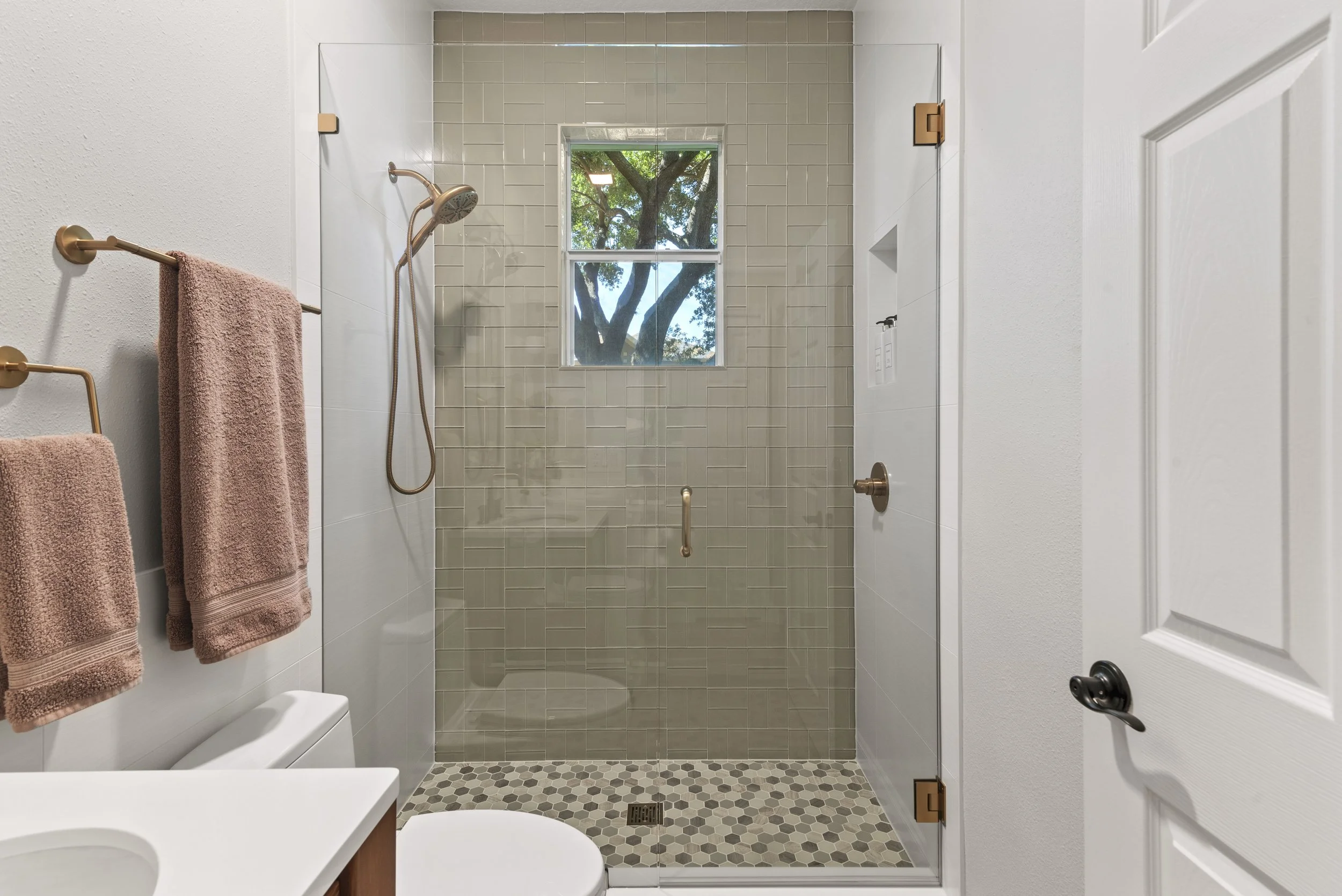
Walk-in glass shower with a gray glass basket weave back wall, 12x24 white tile, and brushed brass fixtures from a tub-to-shower conversion in Winter Garden, Florida.
A tub-to-shower conversion is one of the most popular bathroom upgrades we do in Central Florida. For a homeowner who does not typically use the tub, trading it for a walk-in shower makes sense: a shower you enjoy every day is the better use of that space. A lot of the time the reason is a parent or two moving in and taking over what used to be a guest bath, where a curbless walk-in is easier and safer to step into than climbing over a tub wall. But there is one thing almost no one thinks about before they start, and it is the single biggest reason a tub-to-shower conversion can end up feeling like a downgrade instead of an upgrade.
Here it is. A shower built on the same footprint as the tub almost always feels too small.
The illusion that fools everyone
The inside of a standard tub is not very big. It feels roomy because a shower curtain moves. You brush against it far more than you would guess, and since it gives way every time, your brain never reads the wall as a hard edge. The sense of space stays subconscious and comfortable.
Glass changes that. Your brain knows hitting a fixed panel can hurt, so it starts tracking that boundary on purpose. What used to be a subconscious feeling of room turns into an active thought, and that thought is how small the space really is. The first time your elbow hits the glass while you are washing your hair, or you bump it bending down to wash your legs, the footprint you lived with as a tub suddenly feels like a closet.
This has nothing to do with the tile or the glass you pick. It is what happens the moment a soft boundary becomes a hard one. A one-for-one swap, same size with glass instead of a curtain, is the most common way a conversion lets down the person who paid for it.
Doing it right means growing the footprint
To convert a tub to a shower correctly, you usually have to make the shower bigger than the tub was. That means borrowing space from what sits next to it, which in most bathrooms means the toilet and the vanity.
How much you can borrow depends on the room, and the target is always a standard vanity size so the new one is easy to source and sits right. The play is to step the vanity down to the next standard size, shift the toilet over by that same amount, and give the space to the shower. In a small bath that might be a 36-inch vanity dropping to a 30 and freeing up six inches. On larger vanities the standard sizes tend to step in 12-inch jumps. Now and then you catch a break in an older bathroom where the existing vanity is an odd size, say a 54, and dropping to a standard 48 picks up room without shrinking the vanity much. In our own home we pulled a full foot, but that is one example, not a fixed rule.
Where the extra inches come from
Growing the shower sounds like it means moving plumbing, and relocating a drain in a slab is the expensive part of any bathroom. The good news is you can often find the room without major plumbing work.
Code requires 15 inches from the center of the toilet to the nearest wall or fixture on each side. Plenty of bathrooms are built with more clearance than that, and that extra room is free space you can hand to the shower. On top of that, an offset toilet flange can shift a toilet a couple of inches without relocating the drain line.
On a conversion we did in Winter Garden, the client was confident the same footprint would be fine and asked us to keep it, even after we walked him through how a same-size shower tends to feel. So we built it that way. We framed the curb, moved the drain, poured the concrete, and set the tile backer. Standing in it at that point, he finally saw what we had been describing, and he decided to take on the cost of going back and building it the way we had recommended from the start.
Growing it the second time did not take major plumbing. The toilet already sat about 20 inches off the edge of the original tub, five inches past the 15-inch minimum, so he was comfortable bringing the shower a little closer. Between that clearance and an offset flange, we picked up about seven inches. That is the kind of room that changes how a shower feels, and the reason it cost him extra is that the call got made after the rough work was already in the ground.
Make the call before the plumbing goes in
This is exactly why the footprint is a decision to lock in early, before the plumbing rough-in. A shower wants its drain centered on the floor, and a tub drain sits at one end against the wall, so a centered drain usually means moving the line in both directions. That is the easier of the two relocations, since a shower drain is a smaller pipe than a toilet's waste line and reroutes more readily. It is its own level of difficulty, but not the lift that moving a toilet is. Settle the size first and the drain goes in the right place the first time, instead of getting reworked after the walls are framed.
The other option is a linear drain. It runs along a wall, often near where the tub drain already sat, rather than in the center of the floor. Both are good choices, so the call comes down to the look you want and the layout, not the cost.
A second one, planned from the start
In our own kids' bathroom we knew the trick going in. It had a five-foot double vanity. We are not fans of double sinks in a kids' bath anyway, since two kids at one counter tends to invite trouble, so we dropped it to a four-foot single sink, shifted the toilet twelve inches, and grew the shower twelve inches. The result is a generous shower for a guest or kids' bath without being oversized for the room.
When you should leave the tub alone
Here is the part a lot of people skip past. Keep a tub unless you know this is your forever home.
If resale is anywhere on your mind, a house needs at least one standard tub. A garden tub or a freestanding soaker in the master does not check that box for most buyers, families especially. So a conversion makes the most sense when the home has more than one standard tub to spare.
That was the case on the Winter Garden project above. That same home had a pool bath with its own tub, which we remodeled and kept, so converting the other bathroom into a large walk-in shower added to their everyday life and to the home's value without giving up the tub a future buyer would look for. When the layout and the house both support it, this is a fantastic upgrade.
Tub-to-Shower Conversion FAQ
Do you have to make the shower bigger than the tub? No, but you will regret it. You can physically shower in a small shower the same way you can wear shoes a size too small. It works, but it is not comfortable, and you stop wanting to use it. A tub feels open behind a curtain, and the same footprint in glass reads as cramped, so building the shower a little larger than the tub is what keeps the conversion from feeling like a downgrade.
Can you convert a tub to a shower without moving plumbing? No. A tub drain is not set up for a shower, so the drain always has to be reworked. You can run it as a centered point drain or as a linear drain along a wall, but either way the line gets addressed. The shower drain is smaller and easier to handle than a toilet's, and on the toilet side an offset flange plus any clearance beyond the 15-inch minimum can often grow the shower without relocating the toilet at all.
Should you convert your only tub to a shower? Not if resale matters. A home generally needs at least one standard tub for buyers, families especially, and a garden or freestanding tub in the master does not count. Convert when the house has another standard tub to spare, or when this is your forever home.
Does a tub-to-shower conversion add home value? It can, as long as the home keeps a standard tub elsewhere. In that case a large walk-in shower is a lifestyle upgrade that also helps value. Remove the last tub in the house and it can work against you at resale.
Do you need a permit to convert a tub to a shower in Florida? Yes. Any shower remodel requires a permit here in Central Florida, even when the drain does not move. The work triggers inspections as it goes: a new shower liner gets a pan inspection, a swapped shower valve gets a rough-in inspection, and some municipalities, Seminole County included, require a screw inspection on the tile backer. A licensed contractor pulls the permit and carries it through those inspections, which also protects you when you sell.
How long does a tub-to-shower conversion take? It depends on scope. Swapping only the tub for a shower is fairly quick, but doing it right usually means moving the toilet and replacing the vanity to grow the shower, and once you are touching all three it becomes a full bathroom remodel that runs on that timeline. Our bathroom remodel timeline walks through the stages.
How much does a tub-to-shower conversion cost? Most shower remodels land in the neighborhood of $12,000 for the shower alone. If the conversion grows the footprint by moving the toilet and replacing the vanity, it becomes a full bathroom remodel and the budget climbs from there. Our bathroom remodel cost guide breaks down where full remodels land in Central Florida.
The takeaway
A tub-to-shower conversion is a great project, but it is not a drop-in swap. Treat it as a small floor-plan change, plan the footprint before anyone swings a hammer, and make sure the house can spare the tub. Get those three things right and you end up with a shower that feels bigger than the tub ever did, not smaller.
If you are weighing a conversion, we will walk the layout with you and tell you plainly whether your bathroom and your home are set up for it. For where the budget tends to land, see our bathroom remodel cost guide.