Should You Remodel or Move?
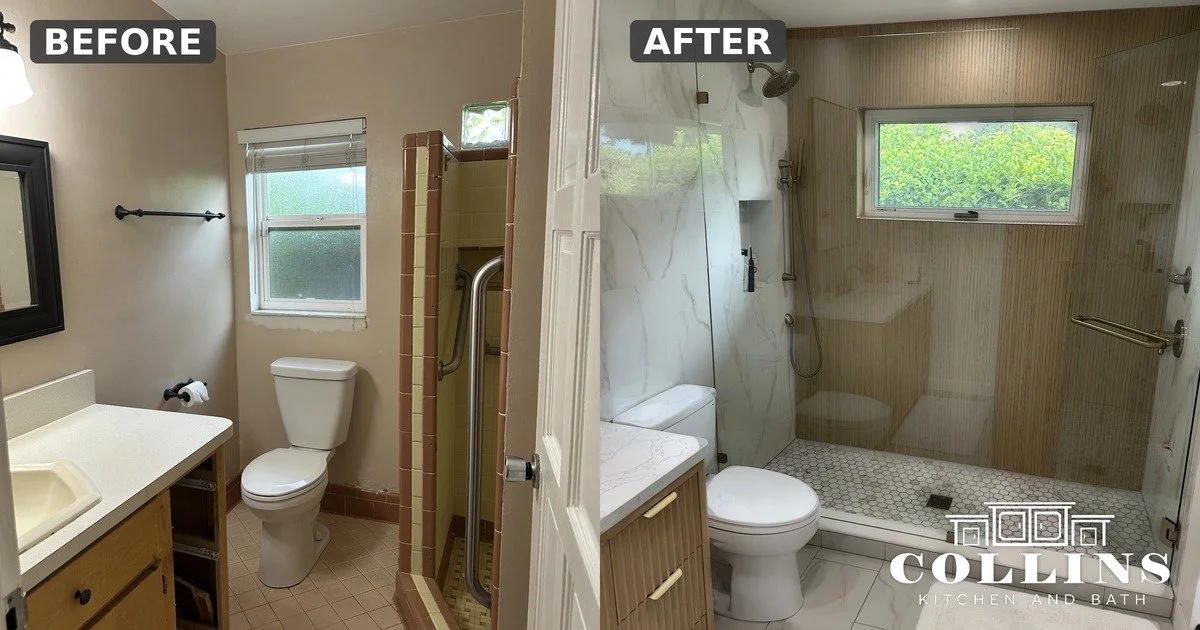
Before and after of a Central Florida bathroom remodel, a dated enclosed shower and worn vanity replaced with a walk-in glass shower, marble-look tile, and a new wood vanity.
When a home stops fitting, the first instinct is to start scrolling listings, but the better question is not which option is cheaper on paper. It is whether the house you have can become the house you want, and whether you still want to be where it sits. Cost is the tiebreaker, not the starting point, and in Central Florida the cost math leans toward staying more often than people expect, for reasons that have nothing to do with the remodel itself. Here is how to think it through before you decide.
Start With Location, the One Thing a Remodel Cannot Change
A remodel can change almost everything about a house except where it sits, so that is the first thing to settle. If you like your street, your commute, the schools your kids are zoned for, the lot, and the neighbors, you have a strong reason to stay and make the house work, because those are the things that are genuinely hard to replace. If the location itself is the problem, too far from work, the wrong school zone, a lot you have outgrown, then no amount of remodeling fixes it, and that points you toward moving. Be clear with yourself on this one before you weigh anything else, because it decides more than cost does.
In our experience, most whole home remodels are not done out of strict necessity. They happen because the owner wants to stay in a particular area and cannot find what they want for sale there. If that is you, a remodel is how you get the home you want without giving up the location you want it in, and that is a sound reason to do it.
Can the House Become What You Need?
The next question is physical. Most of what people want, an open kitchen, another bathroom, a primary suite, a better laid-out main floor, is achievable in an existing home, either within the current footprint or by adding on. Walls move, layouts open up, square footage gets added. What you are checking for is whether the house has good bones, meaning a sound structure and foundation and systems worth building on, and whether the lot and the structure can physically give you what you are after. If you need three more bedrooms and the lot has no room to expand, or the thing you want runs into a constraint the house cannot get past, that is the signal that moving may be the only way to get there. A contractor can walk the house with you and tell you which camp you are in.
The Real Cost of Moving
Moving looks simpler than remodeling, but selling one home and buying another carries its own costs, and they add up faster than most people count. Selling comes with agent commissions, generally in the range of five to six percent of the sale price and negotiable since the 2024 rule changes, plus closing costs and the price of the move itself. Then you are buying, and the home that actually has what you want usually costs more than the one you are leaving, which is the whole reason you went looking. On top of that, if you locked in a low mortgage rate a few years back, moving means taking on a new loan at whatever rate the market is offering now, which can raise your monthly payment even for a similarly priced home. Stacked together, the cost of moving can rival a serious remodel before you have improved your living situation at all.
The Florida Money Realities Most People Miss
This is the part that quietly tips the math toward staying, and a lot of homeowners never factor it in.
Florida's Save Our Homes rule caps how much the assessed value of a homesteaded property can rise each year, at three percent or the rate of inflation, whichever is lower. If you have owned your home for a while, that cap has held your taxable value well below what the home would actually sell for, and your property tax bill reflects the lower number. When you sell and buy a comparable home, the new place is assessed at today's full market value, so your tax bill can jump for what is essentially the same house, and because taxes are folded into most monthly mortgage payments, that increase shows up every month.
Florida does let you carry some of that benefit with you. Portability lets you transfer up to five hundred thousand dollars of your accumulated Save Our Homes savings to a new Florida homestead, but it is not automatic. You have to file for it with your county property appraiser and establish the new homestead within three tax years of leaving the old one, and even then, buying up usually still means a higher bill than the capped one you have now. Remodeling keeps your accumulated benefit intact on the home you already own. The improvements can add some value to your assessment, but you are not resetting your whole tax base to market the way a purchase does. Before you assume a move is a wash, pull your own numbers from the county property appraiser.
Insurance cuts both ways and is worth a look while you are at it. Older homes can cost more to insure in Florida, especially with an older roof, so a newer home can come with a lower premium, which is a point in moving's favor. A remodel that includes a new roof or updated systems can move your premium the other direction. Get real quotes for both paths rather than guessing.
When Moving Is the Better Call
We have walked into homes for a whole home estimate and told the owners, straight, that they would come out ahead by moving. It does not happen on every job, but there are two situations where it is usually the right answer.
The first is when the house would have to change almost everything to work for the person living in it. This comes up most with aging in place, or when an injury or a health condition changes what someone needs from a home. Tight hallways, narrow doorways, level changes between rooms, a second story, a chopped-up layout, all of it can work against someone who needs the house to be safe and easy to move through. Making a home fully accessible can mean widening doorways, moving walls, reworking bathrooms, and flattening the path through nearly every room, and when the whole house has to change at once, the cost runs past what the remodel is worth. In those cases a single-level home that already fits the need, or selling and renting something suited to it, is often the better and faster answer than reworking the house you have.
The second is the neighborhood ceiling. Every area has a top of the market that homes sell for no matter how nice they are inside. If your plans would push your home's value well past that ceiling, you may never get that money back when you sell, and buying a home that already sits higher in the market can be the smarter move. A contractor being straight with you raises this before you spend, not after. If your remodel keeps you in line with your neighborhood or just at the top of it, you are usually fine. It is the remodel that overshoots the whole street that is worth a second thought.
A Whole Home Remodel Is a Lifestyle Investment, Not a Financial One
It helps to be clear about what a whole home remodel is and is not. A whole home is a large share of what a house is worth, so going in expecting to pull every dollar back out the day you list is the wrong expectation. Can you get your money back eventually? Usually. Immediately? Rarely. It is a lifestyle investment first, and for a lot of people an emotional one, more than it is a financial play.
That is not a knock on it, it is the right way to frame the decision. When a home is paid off, bought decades ago for a fraction of today's value, and full of memories you are not ready to give up, you are doing emotional math, not number math, and the emotional answer can be the right one. The homeowners we do whole home remodels for usually fall into that camp, or they are moving in from higher-cost markets like New York or California, cash-heavy from a sale where home values run well above ours and glad to put it into the exact home they want here. Almost none are doing it to turn a quick profit. Go in seeing it as a lifestyle investment and a long hold, and your expectations line up with how it actually pays off.
That is specific to taking on the whole house. A single room is a different story. A bathroom is one of the better returns in the house, and if you expect to sell within about five years it does double duty: you get the use of it while you live there, and the upgrade is waiting for the buyer when you list, so it counts as both a lifestyle and a financial investment. A kitchen costs more and the return depends on more, the scope, the finishes, and above all not pricing yourself out of the neighborhood. Either way, one room rarely puts you in front of the remodel-or-move question at all. It is the whole home, the largest spend of them all, where staying has to be a lifestyle call as much as a financial one.
A Simple Way to Decide
If you want it boiled down, it comes to three questions. First, do you want to be in this location for the next five to ten years? Second, can the house physically become what you need, within its footprint or with an addition? Third, does the remodel cost less than the full price of moving to an equivalent home, counting the commissions, the closing costs, the higher purchase price, and the property tax reset? Our kitchen, bathroom, and whole home cost guides give you real Central Florida numbers to start that comparison. If the answer to all three is yes, remodeling is almost always the better deal. If the location is wrong or the house simply cannot get there, moving is the answer no matter what the numbers say.
Talk to Someone Who Will Tell You Straight
We remodel homes for a living, so it would be easy to tell everyone to remodel. We don't. If a remodel can get you the home you want in the place you already want to be, it is usually the better deal in this market, and we will show you what that looks like. If your situation is one where moving genuinely makes more sense, we will tell you that too. Bring us what you are trying to solve and we will walk your house, give you a real read on whether it can get there, and put together an estimate you can hold up against the cost of moving. Reach out whenever you are ready.