How Long Does a Whole Home Remodel Take in Central Florida?
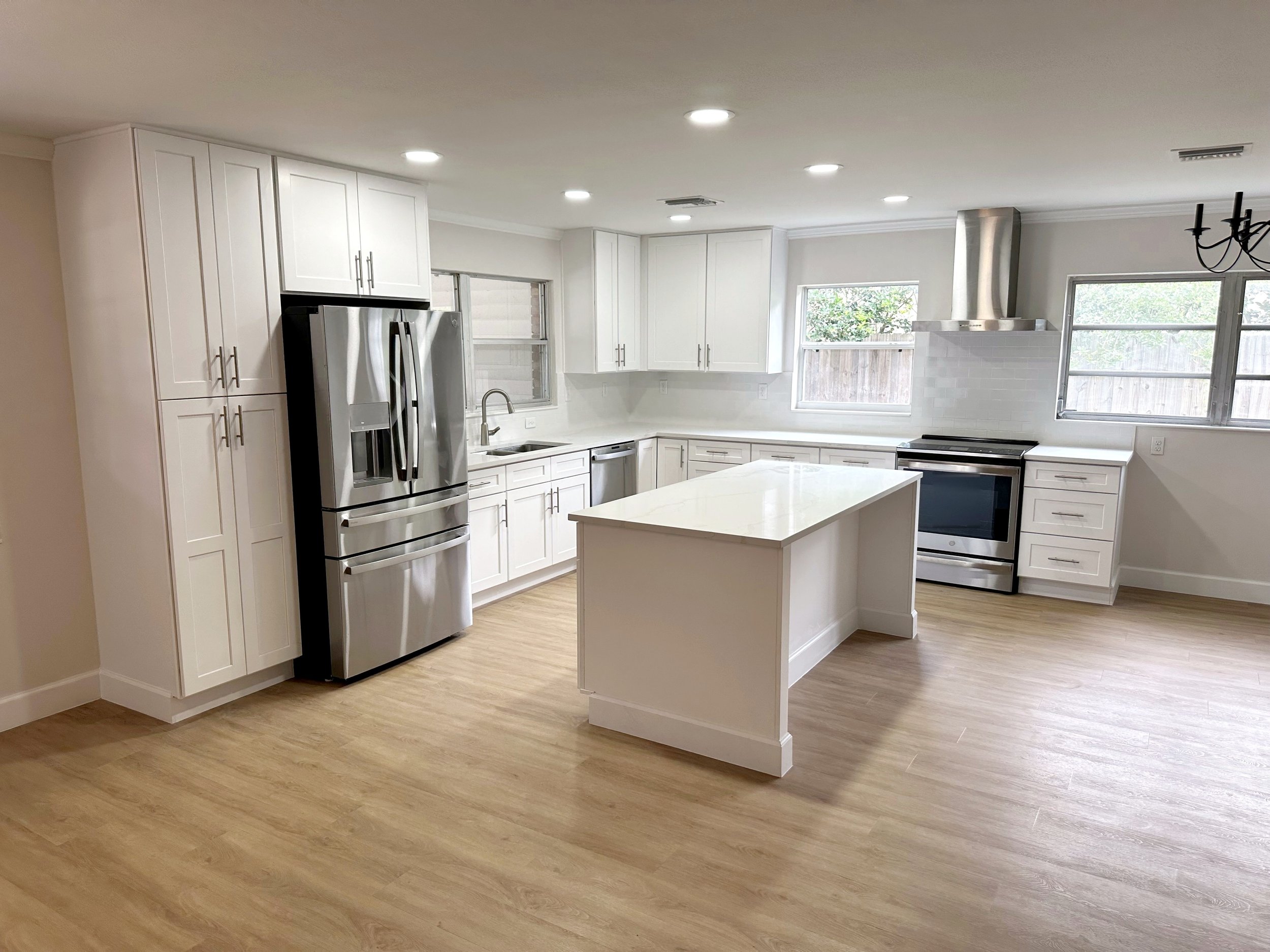
Two-bed, two-bath whole home remodel, 1,285 square feet. The new kitchen has white shaker cabinets, a quartz-topped island, stainless appliances, and wood-look flooring that carries through the home.
A whole home remodel is the largest project we take on, and most people expect it to swallow the better part of a year, but the construction itself is shorter than that. For a typical Central Florida home, the interior runs about four months, right around sixteen weeks from the first day of demo to the final walkthrough. It runs the same phases you would see in a standalone kitchen or bathroom remodel, just across the entire house at once.
Those four months are the build itself, the weeks the house is gutted and the crew is on site. The full calendar from the day you sign runs longer, because the design, the permit, and the materials all come before demo. This post is about the time; the cost side lives in our whole home remodel cost guide. On scope, this is interior work, so any exterior work runs alongside the inside without adding to the timeline.
Before Demo: Drawings, Permits, and Materials
A whole home is a permitted, engineered project, so it starts on paper. We draw the entire house twice. First the as-built, the layout exactly as it stands today, then the proposed plans for the new floor plan, with separate sheets for framing, electrical, and plumbing. When walls move or we change what carries load, those structural sheets have to be sealed by an engineer, which Florida requires for structural work.
The plans go to the county for a permit. Plan review across Central Florida generally runs a few weeks, and it varies from one city or county to the next.
While the drawings and the permit are moving, we lock your selections and get the orders placed. Cabinets and anything else on special order go first, cabinets especially, since custom ones can take up to about twelve weeks. We waste no time on it, because the selections play off each other, and if one piece goes unavailable late it can throw off the entire design. Ordering everything early is how we keep a single back-ordered item from stalling the whole project.
Add it up, and once you have hired your contractor, the design, drawings, permit, and ordering take roughly a couple of months before demo even begins, all of it on top of the four-month build.
The Four-Month Build, Week by Week
Week One: Prep and Demo
Almost every whole home starts with an empty house, either the owners have moved out for the job or, just as often, it is being remodeled before anyone moves in. That changes the pace, because there is nothing to work around. Week one is prep and demo together. Prep is quick, protecting anything we are leaving alone, taking in materials, and dropping the tool and dump trailers on site. Then demo, which takes up most of the week. We strip the house out: cabinets, countertops, baseboards, mirrors, flooring, and any light fixtures that are not staying, leaving only the lights we still need to work by. From there it is the structural side, taking down the walls that are coming out, pulling the dated soffits, and stripping drywall back to the studs so the trades have clean access in the weeks ahead.
Week Two: Layouts and Framing
With the house gutted, this is where we lay everything out. Part of it is the framing changes, usually targeted rather than a whole new floor plan, opening up a wall in the kitchen, extending a shower, framing a bench, or adding a wall where the new plan needs one. The other part is marking where the new kitchen cabinets and vanities will land, on the floor and on the walls, because that is what tells the plumber and the electrician exactly where to set the fixtures when the trades come in.
Week Three: Trades and Inspections Begin
The trades start, and the order matters. Plumbing roughs in before electrical, because it is easier to route wire around pipe than the other way around, and the vent stacks in particular cannot move once they are set. Anything that has to run under the slab, like drain lines or power out to a kitchen island, means cutting chases into the concrete, running it, passing an underground and a pre-slab inspection, and pouring the concrete back. On a larger house the trades often work at the same time to hold the pace.
Week Four: HVAC, Insulation, and Final Rough-In Inspections
The trades stretch runs into week four. The HVAC goes in here, and the rough-in inspections clear. Insulation comes last, after the rough-ins and framing pass, because once it fills the walls it covers everything behind it and nothing can be inspected through it.
Week Five: Tile Backer and Drywall
Now the house closes up. Backer board goes up in the wet areas, the showers and tub surrounds, and drywall hangs everywhere else.
Week Six: Finishing the Drywall
Hanging is the fast part. Finishing is not. The crew tapes, muds, and sands every seam, and on a remodel there is a whole house of repair on top of that, patching anchor holes, nail pops, and years of old fixes, then matching texture so none of it shows. That is slower and more tedious than a new build, where every wall starts clean.
Week Seven: Paint
With the walls finished, the painters take the whole house, ceilings and walls. The doors and the trim get sprayed at the same time but off to the side, so they go in already finished later instead of being brushed in place around a done room.
Week Eight: Flooring
All the flooring goes in across the house, and this is one of the few weeks we want almost nobody else on site. With tile, that is not even a choice, you cannot walk on a fresh floor while it sets. With LVP you could technically run other work, but it is rarely worth it, since crowding the flooring crew slows them down, and that frustration is how mistakes happen.
Week Nine: Showers and Cabinets
With paint and floors behind us, the finish work runs solid from here, close to a month of it without the stop-and-wait of the earlier phases. This week the shower tile goes up and the cabinets get set, kitchen and baths both.
Week Ten: Doors, Baseboards, and Trim Carpentry
The doors and baseboards go in, hung and touched up rather than coated in place, since they were sprayed back in week seven. This stretch is also where the finish carpentry gets going, the wall trim and wainscoting, custom built-ins, shelving, and one-off pieces like a butcher block top in the laundry room.
Week Eleven: Measuring and Feature Walls
With the cabinets set, the countertops and the shower glass both get measured for fabrication. The feature walls go in here too, part of the detail work that makes a house feel built for someone rather than just new.
Week Twelve: Countertops and Backsplash
The tops come in and get set, the backsplashes go up, and the detail work keeps moving.
Week Thirteen: Trim-Out and Appliances
The trades come back to finish. Electrical hangs the chandeliers, the lights, the switches, the receptacles, and the undercabinet lighting. The plumber sets the tubs, the fixtures, and the faucets. The appliances start going in.
Week Fourteen: Final Inspections and Glass
The final inspections happen, the shower glass goes in, and touch-ups run alongside.
Week Fifteen: Detail Overflow and Walkthrough
Any detail work still open gets wrapped, and we walk the house with you.
Week Sixteen: Punch List and Cleaning
The last week is the punch list from that walkthrough and a full clean, then the house goes back to you finished.
Does a Bigger House Take Longer?
For most homes, not by much. People assume a larger home means a proportionally longer remodel, but the timeline usually holds because we size the crew to the job. A smaller home runs with fewer hands and a larger one with more, which keeps the calendar steady instead of stretching just because there is more square footage. A standard Central Florida home, roughly 1,500 to 3,500 square feet, lands in about the same four months either way, and within that range what moves the number most is scope and the things you wait on, more bathrooms, more custom work, the cabinet lead, the permit, and the inspections that gate each phase.
Crew size only buys you so much, though. Some work cannot be rushed by adding people. Tile floors are the clearest example: the field has to be set running one direction so the grout lines carry true from room to room, so you cannot drop a crew in every room at once and expect it to line up. Once a home gets genuinely large, into the 4,000 to 6,000 square foot range, that kind of sequential work, plus more of everything to build and inspect, does push the timeline past four months.
If You Have a Move-In Date, Count Backward
Counting that couple of months of pre-construction and the four-month build, a whole home remodel runs about six months once you have hired your contractor. Choosing the right contractor takes time before any of that, so if you have a move-in date or a month you want to be finished, start meeting with contractors at least nine months out. The earlier you start, the more of that runway is on your side. Reach out whenever you are ready and we will get you in for an estimate.