How Long Does a Kitchen Remodel Take in Central Florida?
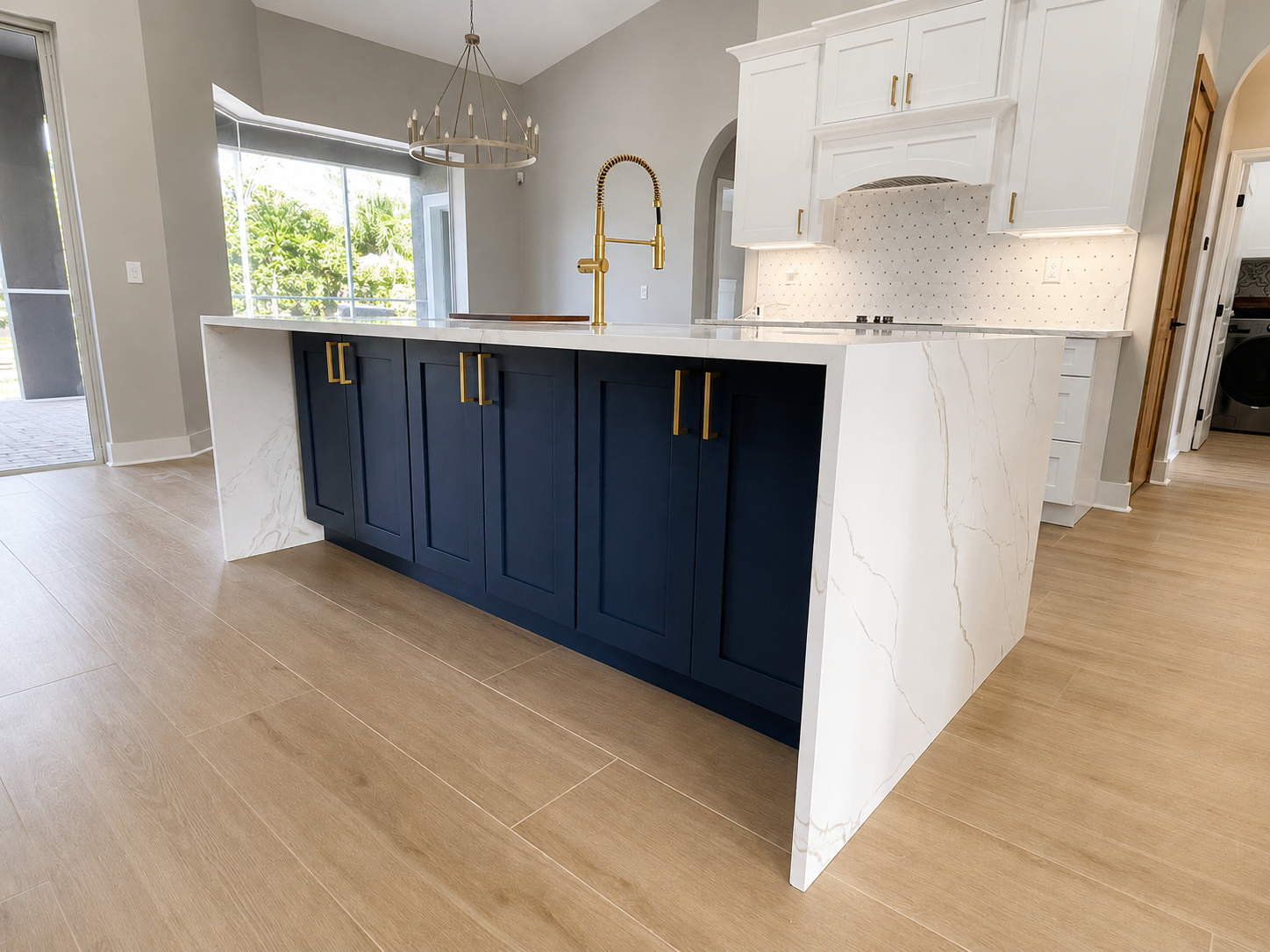
Full kitchen remodel in the Strathclyde community, Apopka. Navy island with a waterfall quartz top, white perimeter cabinets, and a built-in workstation sink.
If you have read our breakdown on how long a bathroom takes, a kitchen will not surprise you. It does not run much longer than a primary bath. The same parts go in, in the same order. There is just more time on cabinets and less on tile. Most full service kitchens, which is the work we do, land in the eight to ten week range, with nine being typical. There is also a faster path when you are keeping the layout, and I cover that at the end.
That is the construction window, the stretch where your kitchen is torn up and the crew is in the house. The calendar from the day you sign runs longer than that, and almost all of the difference is the cabinets.
Before the Crew Shows Up: Selections, Cabinets, and Permits
Once the contract is signed, we confirm your selections and, if the cabinets are custom, order them right away, because they set the schedule for everything that follows. While the cabinets are being built, we handle the architect drawings and the permitting, so both are done by the time the cabinets land instead of stacking onto the back end of the job.
How long that wait runs comes down to the cabinets you pick. Custom cabinets can take up to twelve weeks to build and ship. Ready-to-assemble cabinets, RTA, run only two to four weeks. That one choice is the biggest lever on your whole calendar. It is why we lock the selections and order early, and why we set the construction start so the cabinets land right when we reach the stage to install them, which keeps the stretch your kitchen is actually torn up inside the eight to ten weeks instead of dragging across the entire lead time.
Add it all up, the design, the selections, the cabinet build, the permitting, and the construction, and from the day you first meet with us to a finished kitchen can run up to six months in some cases. That is why it pays to get your estimate sooner rather than later. The clock starts at the first meeting, not at demo.
With that out of the way, here is where the construction weeks actually go.
A Full Kitchen Gut: Eight to Ten Weeks
Week One: Prep, Demo, and Framing
The first week is protecting the home, pulling the old kitchen out, and reframing whatever has to change. A kitchen opens onto the rest of the house, so dust travels in a way it does not in a closed-off bathroom. We set up containment first, then pull the appliances, cap the lines, and kill the circuits before anything comes down. Then we demo the cabinets, counters, backsplash, flooring, and whatever drywall has to open up. How deep the demo goes depends on the house. A lot of Central Florida homes are older, and some sit on a slab with no attic, which changes how the rough-in has to run after.
Week Two: Rough-In
Week two is the trades, and in a kitchen the electrical is the heavy one. A kitchen carries more circuits than any room in the house. The range, the microwave, the dishwasher, the disposal, the refrigerator, the small-appliance circuits along the counters, and all the lighting. The electrical alone can take a couple of days. On a full gut of an older home the electrical can run into five figures on its own, since so much of it is being torn out and replaced. The plumber moves what needs to move for the sink or an island. This is also where the HVAC crew moves or adds any A/C vents the new layout calls for. Gas is uncommon on Central Florida kitchens, since most of them run electric. If the range hood vents outside, the duct gets run now.
Week Three: Inspections
Week three is mostly inspections. The rough-in plumbing, electrical, mechanical, and framing all have to pass. The insulation goes in after those clear and gets inspected last, because once it is in it hides everything behind it. Nothing closes up until each one is signed off. Inspections run on the county's timeline, so there is some waiting built into this week, and we use it on work that does not depend on a sign-off, like painting the doors and trim before they go in.
Week Four: Closing the Walls
With the insulation signed off, the walls close. Drywall first, then paint. We do the drywall and the paint now, before the cabinets, on purpose. We want to set the cabinets against a finished, painted wall, not come back later and try to cut paint in behind a run of upper cabinets. Painting first is cleaner, it looks better where the cabinets meet the wall, and it is one less thing to fight at the end of the job.
Week Five: Paint, Then the Floor
The first half of the week finishes the paint. The second half is the floor. Here is a detail most people never think about, and it changes the order of the whole back half of the job: it depends on what your floor is made of. On tile, the floor goes in first and the cabinets sit on top of the tile. On LVP, it flips. We set the cabinets first and run the LVP around them, because you never set cabinets on top of a floating LVP floor. The plank needs room to expand and contract, and the weight of loaded cabinets pinning it down will buckle it over time. So the flooring you chose decides whether the cabinets go down before or after, and we plan that before we ever start.
Week Six: Cabinets, the Hood, and Measuring the Tops
Cabinets only take a day or two to set. Base cabinets first, leveled and shimmed dead flat, then the uppers. We install the range hood during this stage while we are already in the cabinets. Leveling matters, but not for the reason most people would guess. The countertops will sit fine even if the cabinets follow a crooked floor. Where an out-of-level run shows up is the backsplash. The bottom course of tile follows the top of the counter, so if that line is off, the grout lines taper and the tiles start to look like they grow across the run, and your eye goes straight to it. That is why we set the boxes dead level instead of letting them ride the floor. Once the cabinets are in, the countertops get measured for fabrication, and the trim work can start: the door casings, the baseboard, the crown, all of it.
One of the hardest parts of this week is cabinets that run to the ceiling. A ceiling is almost never truly level and flat, so the gap between the cabinet tops and the ceiling changes as it runs across the wall. The easy way out is to throw a piece of trim up there to cover it, but that almost never disappears. We can see the attempt, and so can the clients we build for. You can get away with about an eighth of an inch. Anything more than that and the eye catches it. So instead of hiding the gap, we fix it. We refloat the ceiling in those areas to bring it flat to the cabinets, which costs us time on this week but is the difference between a kitchen that looks built-in and one that looks close. We ran floor-to-ceiling cabinets down an entire wall on our Sweetwater Cove kitchen in Longwood, and on a run that long there is nowhere to hide an out-of-level ceiling, so every inch had to land right.
Week Seven: Countertops and Backsplash
After the measure, there is usually about a week while the tops are fabricated and brought back. This is the one real lag in the whole job, and the main reason a kitchen flexes between eight and ten weeks. With a fabricator who is not backed up you barely feel it. When the shop is slammed, this is where the extra week shows up. It is the only part of the timeline genuinely out of our hands, which is why we get the measurement scheduled as soon as the cabinets are set, to start that clock early. We keep moving on trim and detail work while we wait.
Setting the tops is a one-day job once they come in, and the backsplash goes in the same week. This is also where the minor touch-ups start and we shift our focus to the detail work.
Week Eight: The Trades Come Back
Now the electrician, the plumber, and the HVAC crew come back to trim out. Switches, receptacles, under-cabinet lights, the faucet, the dishwasher, the disposal, and the ventilation hookups. All the other appliances go in this week too, after the counters are set, since there was no reason to put them in earlier and risk them sitting in the middle of the work.
Week Nine: Final Inspections and Touch-Ups
The last week is the final inspections, the walkthrough, and the touch-ups. A typical kitchen lands right around here, at nine weeks. A clean, simple gut can come in closer to eight. Add a countertop backlog and you are at ten. That spread is almost entirely the one wait in the middle, not the hands-on work.
A Same-Layout Refresh: About Four Weeks
Not every kitchen is a full gut. When the layout stays exactly where it is, when we are not moving a sink or a wall, not adding appliances, just pulling and reinstalling the same refrigerator, microwave, and dishwasher on the connections that are already there, the whole job compresses to about four weeks.
It moves faster because the slow parts of a full gut are gone. There is no rough-in, no inspections gating the walls, and no waiting on a layout that has to be built before anything else. Here is how that month runs:
Week one: demo and drywall.
Week two: drywall and paint.
Week three: cabinets.
Week four: countertops, backsplash, and the finishing details.
There is one more reason this version is simpler. In most municipalities, simply pulling the old cabinets and tops and setting new ones in their place does not require a permit, because nothing structural, electrical, or plumbing is changing. That is not universal. The rules vary from one Central Florida city to the next, and we confirm it for your exact address before we start. If your city does require a permit for this scope, add about a week for that step, which puts the refresh closer to five weeks. Either way, skipping or shortening the permit and inspection cycle is a big part of why a refresh moves so much faster than a full remodel.
A refresh still waits on the same cabinet and countertop lead times up front, so the ordering happens just as early. The difference is all in the build.
A Kitchen Is the Hardest Room to Lose
Everything above is a rule of thumb, not a rigid script. A bathroom you can lose for a few weeks and still get by. A kitchen is the hardest room in the house to lose, which is why the smartest thing we do is schedule the whole remodel around your calendar before we ever start.
Once a kitchen is torn out, we cannot shuffle the work around and hand you a working stove for a weekend. The sequence runs in order, start to finish. So if there is a trip, a holiday, or anything else you need the kitchen for, we build the start date around it up front, rather than fight the calendar in the middle of the job when there is nothing we can do about it.
Inspections on a Kitchen
A full kitchen gut runs through a string of inspections, each one scheduled, passed, and cleared before the work it covers can move forward:
Underground plumbing, when drainage has to run under the slab, which a kitchen island often requires
Pre-slab, before the slab is poured back over the underground work, whether that is plumbing or electrical
Rough-in plumbing
Rough-in electrical
Rough-in mechanical, for the hood duct and ventilation
Roofing, when a vent boot is added or moved to a new spot on the roof
Framing
Insulation, which has to come after the rough-ins and framing pass, since it covers them
Final plumbing
Final electrical
Final mechanical
Final building
Not all of these apply on every job, and the exact list depends on the county, since we work across a lot of Central Florida jurisdictions and they do not all run it the same way. But the cadence is the same idea as any permitted job. Each inspection gates the next step, and that is part of why the calendar fills faster than the hands-on labor alone would suggest.
Why It Takes This Long
A kitchen takes eight to ten weeks because the work runs in order and each step depends on the one before it. Take a shortcut on any of it and you do not save time, you move the problem to the end of the job, where it is harder and more expensive to fix. Anyone promising a full gut in a couple of weeks is either skipping the parts you cannot see or has not counted the lead times that are coming either way.
The hardest delays are the ones nobody can plan around. We had a kitchen where the cabinets were fully custom, the kind you cannot just reorder from a catalog if something goes wrong. They were paid for and already in production, set to arrive a week before install, so we started the demo on that schedule. Then Hurricane Helene tore through the Carolinas where they were being built and devastated the area. The cabinets landed six weeks late. We had done everything right on our end, and it still got knocked off schedule by something nobody could control. That is just how it goes sometimes. Even when every step is done right, an outside event can move the date, and there is nothing to do but deal with it. The same thing hit the whole industry during Covid, when materials and cabinets that used to take weeks were suddenly months out. It does not happen often, but when it does, no amount of planning makes it disappear.
If You Have a Date in Mind, Work Backward From It
The single most useful thing you can do is start early. If you want your kitchen finished by a certain date, count back from it now. Hoping to host Thanksgiving in your new kitchen? You should be calling us no later than March. The sooner we sit down, the sooner the clock starts, and the more of that six-month window works in your favor instead of against you. When you are ready, reach out and we will get your estimate on the calendar.
If you want a fuller picture first, here's how we approach a kitchen remodel from start to finish.