How Long Does a Bathroom Remodel Take in Central Florida?
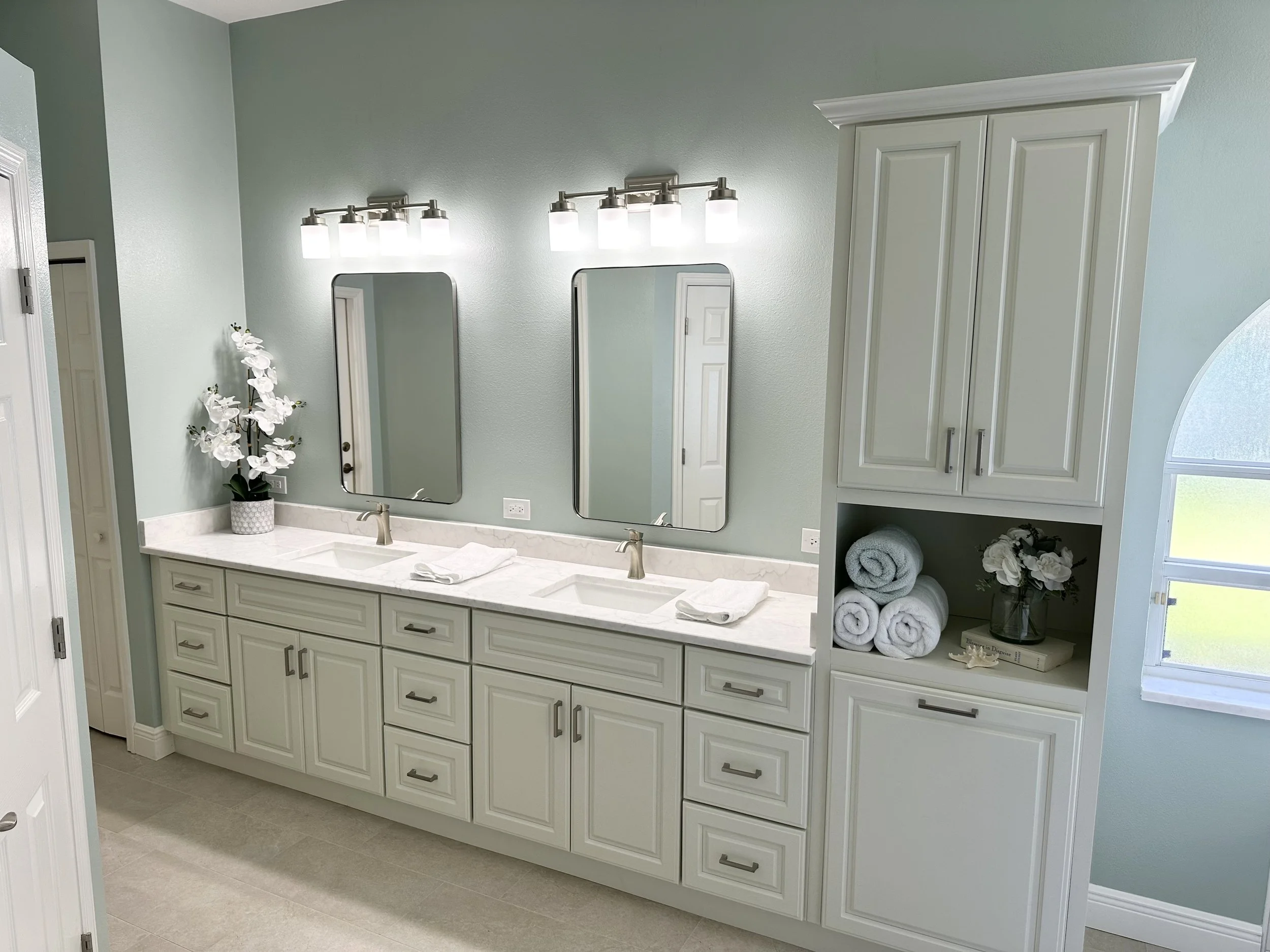
Primary bathroom remodel in Gatlin Woods, Orlando. This one ran about six weeks. With no drain to move we saved a week, but waiting on the countertops and building out the customized tower added it back.
A full guest bathroom remodel in Central Florida averages about four weeks. A primary bathroom can take up to six or seven weeks. I know that sounds crazy, so hang in there and read through this. Those are full gut timelines with permits, done the right way. The size of the room is not what sets the schedule. The work inside the walls and under the floor is, and that work has to happen in a specific order that cannot be rushed without it showing later.
We just finished a primary bath that ran the full six weeks with permits, and a guest bath in our experience runs closer to four. Here is where the time actually goes on both, and why the order matters as much as the days.
When you're ready to plan yours, here's how we handle bathroom remodeling in Orlando.
A Primary Bathroom: Six Weeks
Week One: Prep, Demo, and Framing
The first week is protecting the home, demoing the bathroom, and reframing whatever needs to change. How far the demo goes depends on the space, since some jobs come down to the studs and slab and others do not. Demo is not always the quick part people assume it is. Plaster walls can take days to bring down, and some old tile floors only come up in quarter-sized chunks, so a teardown that looks simple can eat more of the week than expected.
Framing comes next, and it is where a good job is either set up to succeed or quietly set up to fail. The walls have to be straight and the substrate has to be right long before anyone thinks about tile, because everything that comes later sits on what gets built now. We are already thinking about the finished product in week one. That is the part most people never see.
Week Two: Trades and Concrete
Week two is the trades. Electrical, plumbing, and mechanical all rough in during this stretch. And if the layout changed and we have to move a drain line, that one decision adds real time, because moving a drain means cutting the slab, running new underground plumbing, and pouring it back, with an inspection gating nearly every step. In the worst case that single change can run the better part of two weeks on its own. We lay out exactly what that looks like in the inspections section below.
None of this shows in the finished room. Nobody walks in and admires the rough-in work. Well, almost nobody. Some people love looking at this kind of work the way we do, and if you have read this far down the page, you are probably one of them. This is the week that decides whether the sconce placement works with the vanity and the mirrors, whether the shower drain is centered, whether the shower doors clear the fixtures instead of colliding with them, and a dozen smaller things like it. All of it has to be right before the tile goes in, not once it is on the wall, because once it is on, none of it moves without some deconstruction, and that is what we work to avoid. We do not always avoid it. Even with this much intentionality up front, you will always run into something on a project. How that something gets handled is what separates a good company from a bad one.
Week Three: Inspections and Closing the Walls
Before we can close up a single wall, the work behind it has to pass. The framing gets inspected and the insulation gets inspected, on top of the rough-in inspections from the trades. Only after the right ones pass do the walls close, and closing the walls means more than drywall. It includes setting the tile substrate in the wet areas, and in some counties that substrate gets its own inspection before any tile can go on.
These inspections are not a formality and they are not a delay. They are the checkpoint that confirms what is behind the wall is correct before it disappears.
Week Four: Tile
Week four is tile, and it is the most detail-heavy phase of the project. Not because it is the slowest, but because tile is the most unforgiving thing in the room that actually gets seen. The work inside the walls has to be right too, but it stays hidden. Tile is on display, so every cut, every line, and every shortcut taken upstream shows in the finished surface and stays there for good.
This is where the decisions made back in framing come home. If the tile backer was set right, tile goes on clean and the lines run true. If it was not, this is the week the problem surfaces. Fixing it falls on us, not on you. It costs us money, it costs the project time, and it costs you the frustration of watching work come back apart and wondering whether we know what we are doing. Good tile work is not just a skill at the end of the job. It is the payoff for getting the first three weeks right.
The moment the tile is in and true, we measure for the shower glass. Glass is cut to the finished tile, not to a drawing, so it cannot be ordered until the tile is set. And because it can take up to three weeks to manufacture, we measure it the day the tile is done to start that clock as early as possible, rather than waiting until the end and letting the lead time stretch the finish.
Week Five: Finishing the Drywall, After the Tile
This is the step that surprises people. The drywall went up when we closed the walls in week three. We will occasionally put a base coat of tape and mud on it, but we do not take the finishing any further, no floating it out, no sanding, no texture, until the tile is in. That runs against the order most crews use, and it is deliberate.
When the tile goes in, it always goes in straight, so the glass can be cut straight later. Then we float the drywall out to meet that tile, which makes crooked walls and small imperfections disappear into the finished surface. We do not always get to shift the framing, and we did not lay the original block walls that the furring strips attach to, so we are almost always building off of another contractor's work. You cannot always tell how far off a wall is from the start, so finishing to the tile is how we make the whole room read clean. We protect everything while we work back over it, covering the tile walls in plastic and the floors in ram-board. We have learned this the hard way. Finishing the drywall first and tiling second does not mean tearing the board back out. It means floating over it again, sanding again, texturing again, and repainting if the paint was already on. Doing it in that order just builds in a second round of finish work, so we flipped it.
Week Six: Installs, Detail Work, and Glass
The final week is the vanity, the fixtures, the trim, the detail work, and the glass. The glass was measured back when the tile went in, so by now the panels are manufactured and ready to set. Because that lead time can run up to three weeks, the glass is often the last piece to land and the one that completes the room. That is one more reason the front of the job has to be right. A wall that is out of square in week one becomes a glass panel that will not sit right at the end.
When a Primary Runs to Seven Weeks
Six weeks assumes a fairly standard finish. A primary can run into a seventh week when there are custom cabinets, because the cabinets have to be installed before we can measure for countertops, and the countertops then have to be fabricated and set. Until those counters are in, the mirrors and fixtures cannot go up either. So between the countertop fabrication and the shower glass, the last stretch can come down to waiting on outside vendors rather than on our crew. We measure both as early as the work allows to keep that wait as short as it can be.
A Guest Bathroom: Four Weeks
A guest bath is smaller and simpler, so the same work compresses. Demo and framing usually take a few days instead of most of a week, which means the plumber and electrician can start during week one. The trades finish and the inspections pass in week two. Tile in a smaller room is only a few days rather than a full week, so by the end of week three the tile is done and installs are already starting. Week four is finishing the installs and the detail work.
The finish sequencing does not change. The drywall is still floated out to the tile and finished afterward, just folded into those same four weeks. Shaving a day or two off each week on a smaller room does not sound like much, but across four weeks it is exactly what separates a four-week guest bath from a six-week primary.
Every Project Is Different
Everything above is a general rule of thumb, not a rigid script. The timelines hold for most full guts, but we plan each job around two things that change week to week: our crew's schedule and your life.
If our tile crew is tied up on another project and cannot be in two places at once, we may finish the drywall first and bring the tile in once they are free. If you have a vacation coming up or guests heading into town, we will switch around whatever can be switched to work with it. We look at every project and every client's situation on its own and build the plan that fits, rather than forcing the same calendar onto everyone.
Up to Twelve Inspections on a Single Bathroom
People are surprised that one bathroom can require this many sign-offs, but a full primary bath gut can run up to twelve separate inspections across the job:
Underground plumbing
Pre-slab
Rough-in plumbing
Rough-in electrical
Rough-in mechanical
Framing
Screw inspection on the tile substrate (where the county requires it)
Insulation
Final plumbing
Final electrical
Final mechanical
Final building
Not all of these apply everywhere. The screw inspection, for example, is not standard. Seminole County specifically requires it on the tile substrate, where the inspector confirms the backer product we chose is installed to the manufacturer's standards. And if the job has to vent out through the roof, you can add a roofing inspection on top of it. The exact list depends on the county, since we work across a lot of Central Florida jurisdictions and they do not all run it the same way.
Here is what that cadence looks like in real time. When a job requires moving a drain, the slab and underground work alone runs like this:
Day 1: Underground plumbing. Cut the slab and run the new drain.
Day 2: Underground plumbing inspection.
Day 3: Termite spray (soil treatment).
Day 4: Rebar and visqueen down to prep for the pour.
Day 5: Pre-slab inspection.
Day 6: Pour concrete.
Day 7: Plumbing rough-in, such as setting the shower liner on the new slab.
Day 8: Rough-in inspection.
That is eight working days on the underground and slab work alone, before a single wall closes, and it is the worst case. We work around the waiting where we can. While an inspection is pending we will paint doors and trim, and if an inspection passes in the morning we can often prep for the next step or pour the same afternoon and save a day. But the order itself cannot be skipped. You cannot pour over plumbing that has not been inspected, and you cannot rough in over a slab that has not been poured. The schedule moves one approved step at a time, and there is no significant way past that.
Each inspection has to be scheduled, passed, and cleared before the work it covers can move forward. That is why the calendar fills up faster than the hands-on labor alone would suggest. The hours of actual work are only part of the timeline. The other part is the inspection cadence, and that is not something a good contractor can or should try to rush.
Why It Takes This Long
It sounds like a lot of time for one room, and it is. But a proper full gut takes this much effort because the details do not arrive at the end of the job. They run through the whole thing, in order, and each one depends on the one before it. The framing has to be right so the tile backer is right. The tile backer has to be right so the tile is right. The tile has to be right so the glass fits. Pull any one of those out of sequence or rush it, and the problem does not stay where you cut the corner. It travels downstream and lands in the part of the room everyone can see.
Even doing everything right, the details chase you to the very last day. We recently finished a bathroom built on a block wall, the kind of wall we do not normally have to open up. Everything looked right. Then the vanity went in and we could see the drywall had bowed inward, leaving a quarter-inch gap across an eighteen-inch run behind it. We were already at the install stage with the paint done. So we pulled back, spent a couple of hours mudding, sanding, and re-texturing, and made it right. A crew promising a two-week turnaround would have run a bead of caulk across that gap and called it finished.
That is the honest answer to why a bathroom takes four to six weeks. A guest bath runs shorter because it is smaller and simpler. A primary runs up to six because there is more of everything, more trades, more tile, more detail, and more inspections gating each step. If someone quotes you a full gut on a fraction of that timeline, they are not faster. They are skipping steps, and the steps they skip are the ones inside the wall where you will never see them until something goes wrong.
We are a veteran-owned, state-certified contractor, and we would rather take the weeks and do it in the right order than hand you a room that looks finished and is not. The time is the work. The work is in the details. And the details start in week one and do not stop until the last panel of glass is set.